
Live Roulette UK: English-Speaking Dealers and Rules
 Available in GB
Contents
A practical guide to licensing, operator checks, table conditions, money limits and what free or live-variant roulette really means.
The Licence Behind the Casino Door
A roulette table online can look like a room with its own rules: a wheel, a dealer, a field of numbers and a stream of wagers. Yet the more important arrangement sits outside the game. In Great Britain, commercial gambling is overseen by one regulator, the UK Gambling Commission. Its remit includes online casinos, so a digital roulette room is not beyond the reach of regulation merely because no physical casino door opens onto the street.
That authority has a geographical shape. The Commission regulates remote gambling offered to consumers in Great Britain even when the equipment that runs the service is located elsewhere. A server’s address, then, does not determine which rules apply to a casino offering gambling to people in Britain. The relevant question is where the gambling is being offered, not where the machinery happens to sit.
This is a useful distinction in a market where a website can appear placeless. The screen may give no hint of the legal structure behind it, and the language of global entertainment can make every operator seem equally available. But the regulator is not a decorative name in the footer. Its jurisdiction makes the operator’s legal status part of the service itself.
The Commission’s role also has a limit. It is the sole regulator for commercial gambling in Great Britain, rather than a universal authority for every part of the United Kingdom. That distinction matters because the legal map is not quite the same as the map on a travel poster. For someone considering a roulette casino in the UK, the wording of the relevant licence and the market it covers deserve more attention than the broad impression that a site is “British”.
Two kinds of licence
The Commission’s licensing system distinguishes between the business providing gambling and certain individuals working within the industry. An operating licence belongs to a business: it authorises the company to provide the gambling activity covered by its licence. A personal licence, by contrast, is held by an individual in a relevant role within gambling operations.
Mines Casino Game UK: Demo, Rules and Risks
The difference is practical, not ceremonial. A casino is not licensed simply because a named employee has a personal licence, and an individual licence does not take the place of the business authorisation. The company offering roulette online is the central point of concern for a player assessing whether the service is authorised. Personal licensing sits alongside that structure, applying to people rather than to the casino brand as a whole.
The distinction can be easy to miss because websites present themselves as single, polished identities. A familiar name, a well-designed lobby and a row of live tables can make the operator seem self-evident. Legally, however, the visible brand and the business holding the operating licence may not be expressed in precisely the same way. The licence is attached to the authorised business, not to the atmosphere created by the website.
That is why a claim of regulation should be treated as something to verify, not merely as reassurance supplied by the operator’s own pages. Before depositing, the operator’s licence number should be checked against the Gambling Commission’s public register. This is not an exercise in ranking roulette casinos or deciding which table looks most appealing. It is a basic check on whether the business behind the offer appears in the regulator’s record with the relevant authorisation.
A number printed in a footer is only a claim until it is compared with the register. The check should concern the operator itself, not just a game provider, a payment service or another company mentioned on the site. Those names may appear in different parts of the service, but they do not answer the central question: which business is providing the gambling?
The register is a public record, not an endorsement of a particular roulette table or a promise that every aspect of an experience will suit every player. Its importance is narrower and more fundamental. It gives a way to check the regulatory identity behind a commercial offer instead of relying on presentation alone. A polished interface can be copied. A licence has a regulator behind it.
Verifying Operator Licence
Find the licence number
Locate the operator’s licence number, typically found in the website’s footer.
Access the public register
Visit the UK Gambling Commission’s public register.
Compare the details
Check that the licence number, business name, and domain match the record in the register.
The room and the jurisdiction
Remote gambling complicates the old image of regulation as something attached to a building. A land-based casino has an address and a visible entrance; an online casino can serve people in Great Britain while its key equipment sits elsewhere. The Commission’s approach follows the activity offered to consumers rather than the location of that equipment. The digital room still has a jurisdiction.
This is especially relevant to searches for UK roulette casinos, where the word “UK” can describe a target market, a brand’s style or a claimed connection to Britain. None of those labels alone establishes that the business holds the necessary operating licence. The regulatory question is less atmospheric: does the company offering the gambling hold the appropriate authorisation from the body responsible for commercial gambling in Great Britain?
The answer should be established before money enters the account. That sequence is not bureaucratic fussiness. Licensing is the part of the arrangement that identifies who is answerable within the regulated system. Without that foundation, a roulette interface remains only an interface—convincing, perhaps, but not proof of who stands behind it.
Live Roulette Online: The Operator Still Matters
Roulette can be easy to find online. That is not the same as establishing that the business offering it is permitted to serve customers in Great Britain. The distinction is less visible than a wheel on a screen, but more important: a game is a product; the operator is the business responsible for making it available.
Live Dream Catcher Casino UK: What to Check
A search for live roulette UK with English-speaking dealers may bring up casino pages, game previews and invitations to open accounts. Their shared vocabulary can make them appear interchangeable. They are not. The relevant question is not simply whether a site displays roulette, but whether the remote gambling operator behind it holds the licence required to serve Great Britain consumers.
The Gambling Commission requires remote operators serving people in Great Britain to hold the relevant licence. That requirement follows the market being served, rather than the place where a company is based or where its key equipment sits. A polished site, familiar currency or British-facing wording cannot substitute for permission from the regulator.
This is why the operator deserves attention before the table does. Casino pages are designed to put games in view: roulette may sit beside other titles, and the route from a promotional page to registration may be short. The legal status of the business is a different matter. It is not established by the game’s appearance, the site’s presentation or the mere fact that an account can be created.
A name on a website may also differ from the legal name of the business holding the licence. That makes the public Gambling Commission register useful as a point of verification, rather than treating a logo or a licence claim on a casino page as the final word. The licence number should be checked against the register before a deposit is made. The aim is to connect the visible brand to the regulated operator responsible for it.
Do
- Verify the operator’s licence on the public register
- Match the legal business name to the brand
- Check regulatory status before depositing
Don’t
- Rely on a logo or claim on the casino page
- Assume a polished interface proves legality
- Confuse a game provider with the operator
That small act of checking changes the order in which an online casino is considered. Instead of beginning with the wheel and only later asking who runs the room, it puts the business first. In a physical casino, the building and its operator are difficult to separate. Online, a site can be a front end through which games and account services are presented, while the responsible company remains less conspicuous. The screen flattens that distinction; regulation restores it.
For people looking for roulette online in the UK, the phrase “UK casino” can be used loosely in advertising and everyday speech. The licensing question is narrower. The Commission’s requirement concerns operators serving consumers in Great Britain. The label attached to a site does not settle whether the business meets that requirement. Nor does the fact that a roulette game is supplied for an online platform establish that the platform’s operator is appropriately licensed.
The same reasoning applies whether the page is described as an online casino with roulette or as a roulette casino online. Different wording does not change who accepts the customer’s account or makes the gambling available. A game title can be copied, promoted or placed in a menu; the operator’s obligations cannot be inferred from those details. The company behind the service is the part that must be identified.
Online Casino Without ID in the UK: What It Means
There is a social history in this division of responsibility. Gambling once had a visible address: a room, a counter, a set of doors. Remote services have made the venue portable, and with it the temptation to treat a casino as nothing more than a collection of games. Licensing insists on a less convenient idea: an online gambling service still has an accountable operator, even when its presence is rendered as a webpage.
The practical test is therefore not a judgement about whether a roulette page looks credible. It is whether the relevant operator can be matched to the appropriate Gambling Commission licence on the public register. A mismatch or an unclear identity is a reason to pause, not to fill the gap with assumptions. Familiar design is not evidence of regulatory status.
That does not make the wheel less central to the experience. It simply puts it in context. Live roulette is encountered through a remote gambling business, and the business’s authority to serve Great Britain is a separate question from the game’s availability. Before any deposit, the operator’s licence number should be verified on the Commission’s register. Gambling should never exceed what can be afforded to lose.
The wheel is visible. The operator matters.
Roulette Sites and the Slot-Stake Rules That Do Not Apply
A casino website can place roulette and online slots beside one another, under the same account and in the same menu. That visual arrangement makes the games look subject to one tidy set of rules. In Great Britain, however, a rule aimed at one kind of game does not automatically travel across the page to another.
Online slot stake limits (e.g., £5 for adults 25+ and £2 for adults 18-24) apply specifically to slots and do not set the maximum stakes for roulette or blackjack.
The distinction matters when comparing roulette casino sites. The online slot stake limits concern slots; they do not set the maximum stake for roulette or blackjack. A roulette table does not become a slot because it appears in the same digital casino, and a slot does not escape its rules because it shares a lobby with live tables. The category of game, not the design of the website, is the dividing line.
A specialist review describes the Great Britain limits for online slots as £5 per game cycle for adults aged 25 and over, and £2 for adults aged 18 to 24. Those figures belong to the slot context. They should not be read as roulette limits, nor as a general ceiling applying to every game in a casino.
This is an unglamorous distinction, which is often where regulation earns its keep. A shared account can make separate products feel interchangeable; the rules are less impressed by the interface. The relevant question is what game is being played, not whether the roulette table and the slot carousel sit under the same roof.
For someone comparing a roulette casino site in the UK, this prevents a specific misunderstanding: a slot stake restriction is not a measure of what can be wagered on roulette. It also prevents the reverse mistake of assuming that a rule framed for slots has no force simply because other games are available on the same platform. The categories remain separate.
American Roulette Online in the UK: Wheel and Play
That separation says something about how online gambling is governed. The familiar casino floor gathered unlike games into one room, but a digital lobby can make those differences harder to see. Regulation therefore has to attach rules to the activity itself. A roulette wager and a slot game cycle may both involve money and chance; they are not, for this purpose, the same kind of play.
The word “cycle” is important in the slot rule because it describes the unit to which the slot limit applies. It should not be casually carried over to a roulette spin, or treated as a general description of every wager offered online. A label from one game’s rules cannot do the work of a rule for another.
That is why a search for the best live roulette casino sites should not be answered by borrowing slot-limit language. The rule tells something about online slots, not whether a roulette table is live, what its presentation is like, or how a particular casino arranges its games. Those are separate questions. The useful point here is narrower: roulette and blackjack are outside the stated online slot stake limits.
None of this makes roulette risk-free or turns the absence of that particular cap into a recommendation to wager more. The slot limits mark a boundary between game categories; they do not promise a safe outcome at a roulette table. Gambling should never exceed what can be afforded to lose.
Responsible Gambling
Gambling should never exceed what can be afforded to lose.
Recommended online casinos
- JetsetspinsBonus: 200% Bonus + 100 Free Spins + Free Royal Wheel · Payout speed: 1-3 business days
- ChanzeBonus: Slots Welcome Bonus #1 200% up to €500 · Payout speed: 1-3 business days
- SlotoSportBonus: 500% up to £ 10 200+ 777 FS · Payout speed: 1-3 business days
- SpinFormulaBonus: 550% Up To £15,000 + 550 FS · Payout speed: 1-3 business days
- EvoSpinBonus: 125% up to €2500 + 125 Free Spins · Payout speed: 1-3 business days
- ZombillionBonus: Welcome Pack 250% up to £4000 + 200 FS · Payout speed: 1-3 business days
The Live Casino Table, Before the Wheel Turns
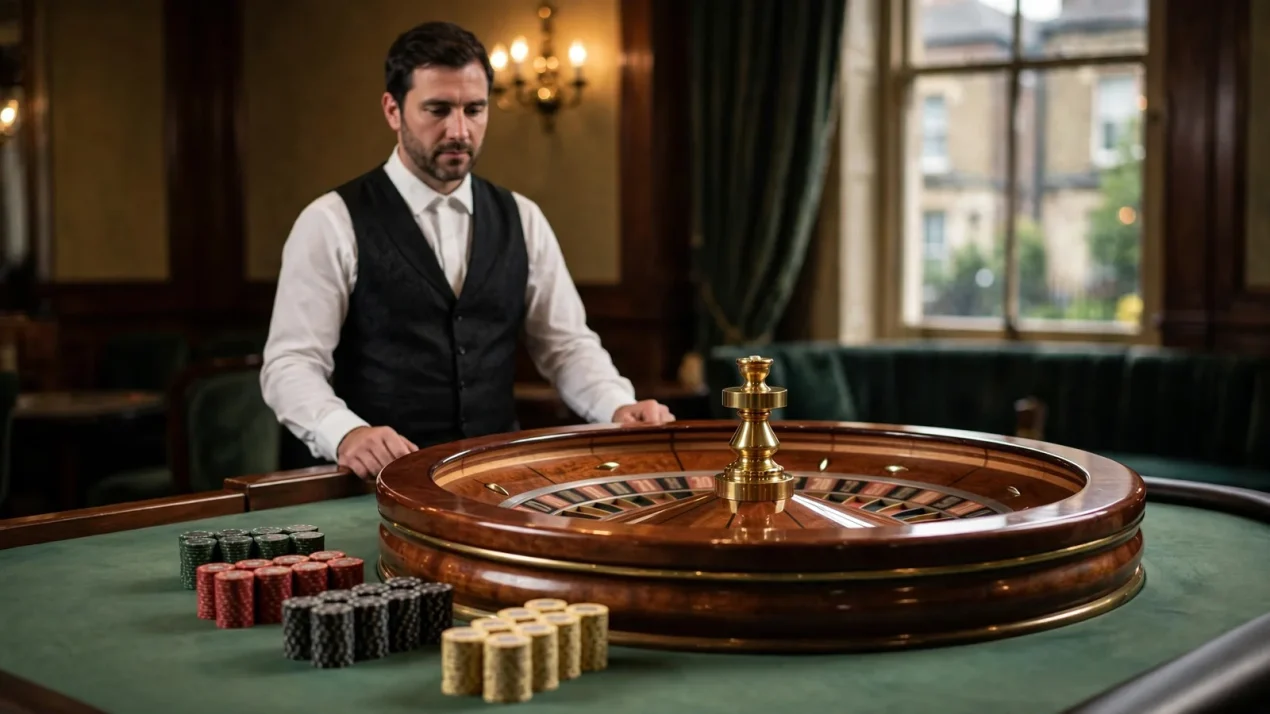
A roulette wheel on a screen can mean more than an animated game. In a live casino, the table is presented as a shared event: a dealer conducts play while the wheel turns, and the screen places the player at a remove from the room but within sight of its rituals. The format borrows the atmosphere of a casino table, where attention gathers around a physical object and a sequence of actions, then carries that scene into online play.
Grosvenor’s live casino launch in 2013 offers a documented British example of that arrival. Its games included Roulette alongside Blackjack and Texas Hold’em, within a broader range of card and casino games. The mix matters. Live casino did not arrive as another name for roulette alone; it presented several familiar table games under one roof, with the dealer and table providing a common frame.
Live Blackjack at Online Casinos in the UK
That frame has an older social logic. Casino games have always depended not only on rules but on the way people gather around them: the turn-taking at a card table, the pause before a result, the visible performance of dealing or spinning. Online, a live table seeks to preserve some of that sequence. Roulette is especially legible in this setting because the wheel makes the central action visible. The game’s drama is concentrated in a small, public movement.
Yet the screen changes the room. Players are not necessarily gathered in one place, and the dealer’s presence is mediated by a camera and interface. A live roulette casino game therefore sits between two habits: the solitary act of using a device and the older spectacle of watching a table in motion. That tension is part of the format, not a defect to be concealed. The table is present, but the room is elsewhere.
Grosvenor’s 2013 offering is useful as a point in the history of live casino games in the UK, rather than as proof that every operator or table works in the same way. It records a commercial arrival with a recognisable game mix: Roulette among card games, not isolated from them. No grand invention was needed. The appeal lay in making established casino games feel conducted in real time, with a person at the table and a sequence unfolding before the viewer.
European Roulette at UK Online Casinos: Rules and Odds
That is why “live” describes more than a category label. It signals a style of presentation in which the pace and visible conduct of a table become part of the game’s appeal. For roulette, the wheel remains the emblem; for the wider live casino, the dealer links games that otherwise have different rules and rhythms.
The format can lend a familiar game a sense of occasion, but occasion is not a reason to wager beyond what can be afforded to lose. A screen can make a table feel close. The consequences remain real.
What “Best” Can Honestly Mean
A “best” label sounds like a verdict, but it often conceals a choice of criteria. A casino may be called the best for roulette because it has a polished live table, a familiar name or a large range of games. None of those descriptions, on its own, establishes that the operator is suitable for people in Great Britain. A ranking without stated, checkable standards is mostly an arrangement of adjectives.
Casino Games: Slots, Live Tables and Crash Games
For a live roulette casino in the UK, the more useful starting point is whether the operator is authorised to serve the British market. The Gambling Commission regulates remote gambling offered to people in Great Britain, wherever the operator’s key equipment is located. Its public register lets a reader check the operator’s licence and the details attached to it. The licence number should be verified there before any deposit is made; a logo or a confident claim on a casino page is not the same check.
That distinction matters more than a decorative “top” badge. A casino can present roulette prominently and still leave the essential question unanswered: who is responsible for the gambling service? The register turns that question from an impression into something that can be examined. It is a modest act of administrative scrutiny, and a better basis for calling one casino preferable to another than an unsupported ranking.
A dated check of the Commission’s register, current to 26 September 2026, found no LuckyPays listing under that brand or the domain it states, including luckypays.io. For anyone assessing a particular casino, the relevant operator identity and domain need to match the entry being checked. A near-match is not confirmation.
Other phrases attached to roulette searches can sound equally decisive. “Best odds” does not identify a better-regulated operator, and a maximum stake or a list of roulette numbers cannot establish that one casino is the best place to play. Such details may describe a game or a table, but they do not replace evidence about who operates the service. The distinction is easily blurred when marketing turns a feature into a verdict.
Live Baccarat Online Casinos in the UK: How They Work
A sensible comparison therefore begins with verifiable safeguards, not a league table. The Commission’s register is public, and checking the licence number before depositing is a concrete step rather than a promise about quality. Beyond that, the word “best” depends on what is being compared and on whether the claim can be substantiated. Without those criteria, it is a sales label.
Roulette remains gambling, not a test with a guaranteed outcome. Any play should be limited to money that can be afforded to lose. No ranking changes that.
Playing for Money: Limits Before the First Deposit
A real-money roulette account begins with checks, not with the wheel. In Great Britain, an operator must verify a customer’s age before allowing a deposit. This places the first barrier at the point where money enters the account, rather than leaving age checks until a withdrawal or a later stage of play. Online gambling is for adults aged eighteen and over when the operator holds the relevant Gambling Commission licence.
There is another pause before the first deposit: new customers must be prompted to set a financial limit. The limit is an account-level control, intended to make a boundary part of the account before wagering begins. Operators must also make limit-setting tools accessible within the account, so the choice is not confined to an initial registration screen and then hidden in the machinery.
Account Safety Steps
- Verify age before making a deposit
- Set a financial limit during registration
- Ensure limit-setting tools are accessible
- Use a permitted payment method (no credit cards)
That matters for live roulette as much as for any other real-money casino game. The pace and presentation of a live table may make play feel continuous; the account controls belong to a different, less theatrical part of the experience. They deal with how much money can be put at risk, not with what happens on the table. A limit chosen in advance cannot turn gambling into a predictable expense, but it can mark a boundary before the atmosphere of play takes over.
Payment rules draw another line. Remote gambling operators cannot accept credit-card payments for gambling, including credit-card funding routed through a money service business. Nor may an operator accept a wallet payment when that wallet allows credit-card funds to be used for gambling. These restrictions concern the route by which money reaches the account, not a particular roulette format.
The safeguards are therefore spread across several moments: age verification before deposits, a financial-limit prompt before a new customer’s first deposit, accessible controls at account level, and restrictions on certain payment methods. None makes a session risk-free. A live table remains gambling, even when its setting resembles a studio and its dealer speaks across a screen.
For anyone choosing to play roulette for money, the practical boundary is plain: gamble only what can be afforded to lose. A limit is useful only if it reflects that boundary, rather than an optimistic guess about what the evening will bring. The wheel has no memory. The account, at least, can keep a limit.
Bonuses, Complaints and the Small Print
A roulette promotion can sound simple in a banner and become considerably less simple in its terms. A welcome bonus, a deposit offer or a no-deposit promotion is not just a headline amount: the written conditions define what the offer means, which games qualify and what must happen before any related funds can be withdrawn. Those details matter more than the label “roulette bonus”.
For a live roulette bonus, the distinction between a table game and other casino games is worth checking in the promotion’s wording. A general casino offer does not necessarily apply to roulette, and a reference to live games does not by itself establish that every live table qualifies. The same care applies to Lightning Roulette: its name in a promotion should be read as a specific inclusion only if the terms actually say so.
A no-deposit offer should not be treated as money without conditions. The promotion may set rules about eligibility or use, and the account terms explain what follows from accepting it. If the wording is unclear, a claim that an offer is “for roulette” cannot settle the dispute on its own. The written terms are the useful starting point.
Complaints are part of the framework around licensed gambling, not an optional courtesy. UK Gambling Commission licensees must provide an internal complaints process and access to an approved Alternative Dispute Resolution service. That gives a customer a route to raise an unresolved disagreement about a bonus, including how the operator applied its published conditions.
A sensible record of the promotion, its terms and any messages about the claim can make the issue easier to explain. The complaint should identify the precise condition in dispute and the operator’s decision; if the internal process does not resolve it, the operator’s information should explain how to access its approved ADR service. Offers are commercial language. A complaints route is the more consequential part of the small print.
None of this makes a bonus a reason to wager beyond an affordable loss. Promotions can alter the shape of an offer, not the financial risk of gambling. Only money that can be afforded to lose should be used.
Free Roulette and the Meaning of “Free”
“Free” can describe roulette played without risking money deposited into a gambling account. It does not, by itself, establish that a casino offers a no-cost version, or explain what conditions apply to one. The word is an invitation to look more closely, not a complete description.
A no-cost game may be a demonstration, with no cash wager and no cash winnings. Its purpose is practice or entertainment: the balance shown within the game is not necessarily money that can be withdrawn. The distinction matters because familiar-looking tables can make very different arrangements seem alike. A roulette wheel on a screen does not tell anyone whether real money is involved.
The other meaning is less straightforward. A promotion may describe play as free while requiring a deposit, imposing conditions on winnings, or placing restrictions on how funds can be used. That is not the same as playing without putting personal money at risk. Those terms belong to the offer itself, and the label alone cannot settle them.
Nor does “free” mean free of consequence. Time spent playing still has value, and a demonstration can make gambling feel routine without carrying the same financial stakes. Moving from a no-cost game to real-money play changes the nature of the activity, even if the interface remains unchanged. No particular free roulette option should be assumed to exist at any casino; availability and the meaning of the label have to be established by the operator’s own information.
A casino’s description of its roulette games may also use names such as French Roulette, but a game title does not clarify whether the play is simulated or for money. The question of free play is separate from the rules attached to a particular roulette variant. Reading the label carefully is more useful than treating “free” as a guarantee.
For real-money play, the distinction is plain: a wager can be lost. Gambling should never exceed what can be afforded to lose. That remains true whether the first step was a free demonstration, a promotional claim or no practice at all. Free is a description of the price at the point of play, not a promise about what follows.
Roulette Outcomes
There is no reliable winning formula for roulette; the outcome always remains uncertain.
Roulette Has No Reliable Winning Formula
The promise of a dependable way to win at roulette is attractive because it turns chance into something that appears manageable. A sequence of wagers can look like a method; a run of results can seem to carry a message. Neither makes the next result knowable. A pattern in past outcomes is not a promise about what comes next.
This is true whether the wheel is in a casino, shown by a live dealer, or part of an electronic game. Changing the setting does not turn chance into a skill that can guarantee a return. Systems that recommend changing wager sizes after wins or losses may organise play, but they cannot make a losing run impossible or ensure that a winning one will continue.
That distinction matters. A plan can set boundaries for spending and time; it cannot provide certainty about the outcome. Treating a staking system as protection against loss confuses control over decisions with control over chance. The first is possible. The second is not.
Searches for a way to win every time ask for something roulette cannot supply. Even a wager that has paid before may lose later, and no arrangement of previous results gives a reliable forecast. A memorable win may invite repetition, while a loss can make recovery feel urgent. Both reactions can pull play away from the limit originally intended.
The sensible measure of a session is therefore not whether a formula was followed, but whether the money and time involved remained within what could be afforded. A strategy that depends on chasing losses is not a safeguard; it is a reason to pause. Gambling should never exceed what can be afforded to lose.
This may sound less satisfying than a secret system. It is also more honest. Roulette offers uncertainty, not a contract with the player. The same caution applies to electronic roulette: its presentation may differ, but it should not be mistaken for a route to guaranteed winnings.
There is no reliable best way to win at roulette, online or in a physical casino. There are only choices about whether to play, how much to risk, and when to stop. The outcome remains uncertain.
Lightning Roulette and the Live-Variant Question
Lightning Roulette belongs to the live-table family, but its name also places it in a crowded catalogue of casino products where a familiar game can be presented as a distinct variant. The word “Lightning” signals a branded version, not a different category of gambling: it remains roulette, situated within the broader live casino landscape.
That distinction matters because the label can invite assumptions. A casino listing may place Lightning Roulette beside conventional roulette tables, other live games and digital slots, but the neighbouring tiles do not make those products interchangeable. “Lightning Roulette slots”, for instance, muddles two categories: a roulette title does not become a slot simply because it appears in a casino’s games menu. The format and the label need to be read together.
The live element is part of the appeal implied by the title. It locates the game among tables presented as live casino entertainment, rather than suggesting a standalone slot. Beyond that, the name alone is not a reliable guide to how a particular table is run or what features it offers. Product details belong to the actual listing, not to the atmosphere created by a dramatic title.
There is also a social distinction. A live table borrows the visible rituals of casino play: a dealer, a wheel and a shared moment of waiting. A variant can alter the framing without erasing that basic setting. The branding does some work; the category does the rest.
For anyone comparing a live roulette table with a digital game, clarity begins with identifying what is being offered, rather than inferring mechanics from a name. No title can turn chance into a method. Only wager what can be afforded to lose.
What are the online slot stake limits in Great Britain?
The limit is £5 per game cycle for adults aged 25 and over, and £2 for adults aged 18 to 24. These limits do not apply to roulette or blackjack.
Are online casino games licensed and regulated?
Yes. The UK Gambling Commission regulates online gambling, and operators serving consumers in Great Britain must hold the relevant licence.
Is LuckyPays licensed by the UK Gambling Commission?
The Commission’s public register dated 26 September 2026 does not show an entry for LuckyPays under that brand or its stated domain, luckypays.io.
Related posts

Terms of Use

Responsible Gambling
