
American Roulette Online in the UK: Wheel and Play
 Available in GB
Contents
The wheel makes chance visible, but its appearance alone cannot explain how play is organised or what a wager returns.
The American Roulette Wheel: Two Zeroes, One Distinctive Difference
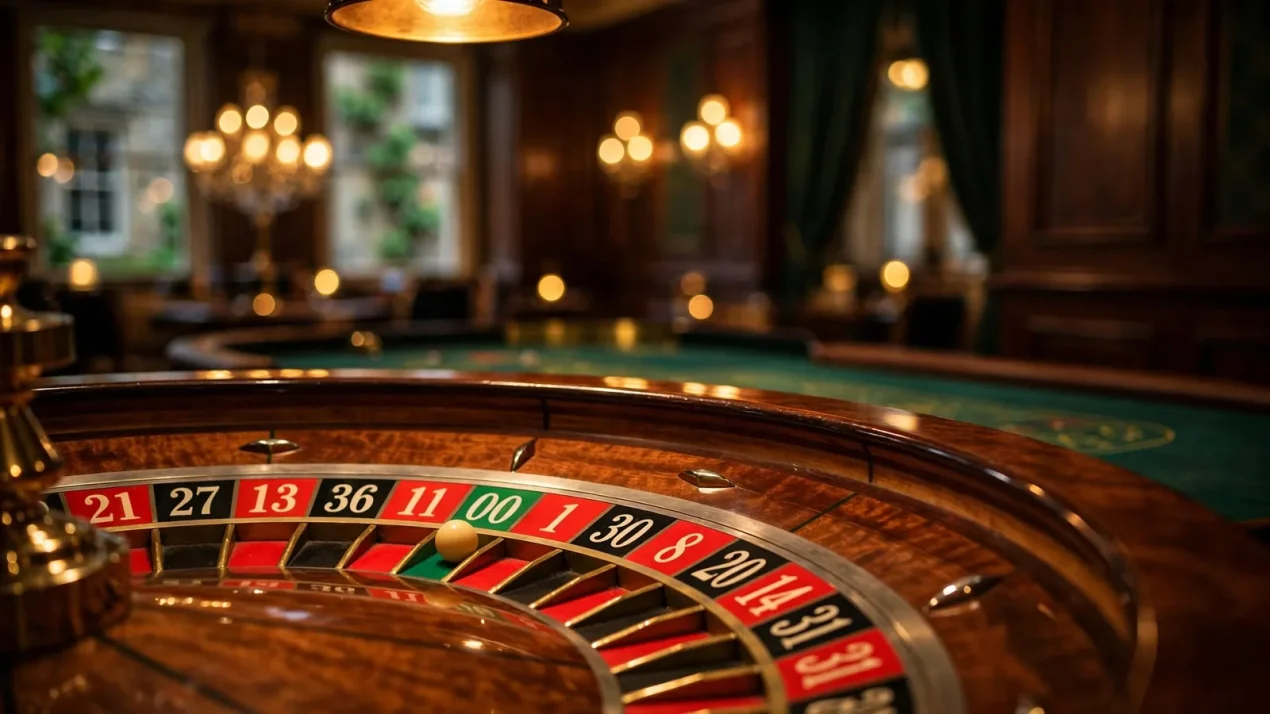
The American roulette wheel is more than a piece of casino equipment in the imagination: it is the game’s central image. A turn of the wheel makes chance visible. The outcome is not presented as a calculation unfolding quietly behind a screen, but as a result that appears to travel, hesitate and settle. That small drama has helped roulette endure as a recognisable casino game, even as its setting has moved from physical rooms to online play.
The wheel also gives the game a particular kind of ceremony. Players may watch the same movement while attaching very different hopes to it; the object itself offers no account of what a result means. Its authority is theatrical rather than explanatory. It makes randomness seem close enough to follow with the eye, while leaving the underlying question of chance untouched.
That distinction matters when the name American roulette is encountered. The name identifies a version of roulette, but a wheel’s appearance alone cannot explain how a game is organised or what a wager would return. Those are separate questions. Here, the focus is the wheel as the emblem around which the game’s identity gathers, not the markings or betting areas of a table.
Online, that emblem becomes an interface. A digital presentation can make the wheel the visual centre of the game, but the screen does not turn its imagery into evidence about the rules. A player seeing an American roulette wheel online is still encountering a casino product whose operation belongs within the wider system of British gambling regulation. The UK Gambling Commission regulates remote gambling offered to consumers in Great Britain, wherever the equipment that runs it is located. The setting may be a screen; the regulatory responsibility does not disappear with the change of room.
There is a social history in that contrast. Casinos have long arranged games so that uncertainty can be watched as well as experienced. The wheel gives chance a public face, even when the person playing is alone at home. In that respect, online roulette preserves an old performance in a new setting: the event is made visible, while its outcome remains beyond the player’s control.
Online Bingo UK: How Bingo and Casino Games Connect
The attraction is easy to understand, but the symbolism can mislead. A wheel is not a promise of momentum, a pattern, or a hint about what comes next. Its movement is spectacle, not a message. The distinction is plain.
American roulette belongs to a market in which online gambling is legal only through licensed and regulated sites. That framework speaks to the conduct of operators, not to the wheel’s supposed personality. The wheel can be captivating without being prophetic; it can make a result feel momentous without changing the nature of chance.
Roulette’s image is therefore unusually durable: a compact emblem of anticipation, repeated in casino rooms and digital displays. Its cultural force comes from what people bring to the moment, not from any assurance the object can provide. Gambling should remain within what can be afforded to lose.
Recommended online casinos
- JetsetspinsBonus: 200% Bonus + 100 Free Spins + Free Royal Wheel · Payout speed: 1-3 business days
- ChanzeBonus: Slots Welcome Bonus #1 200% up to €500 · Payout speed: 1-3 business days
- SlotoSportBonus: 500% up to £ 10 200+ 777 FS · Payout speed: 1-3 business days
- SpinFormulaBonus: 550% Up To £15,000 + 550 FS · Payout speed: 1-3 business days
- EvoSpinBonus: 125% up to €2500 + 125 Free Spins · Payout speed: 1-3 business days
- ZombillionBonus: Welcome Pack 250% up to £4000 + 200 FS · Payout speed: 1-3 business days
Reading the American Roulette Table
An American roulette table is best understood as a map for placing wagers, not as a picture of the wheel. The wheel is where the result is produced; the felt or digital layout is where a player indicates which outcome is being backed. The two are related, but they serve different purposes. Confusing them can make a familiar-looking screen seem more self-explanatory than it is.
On a casino table, the printed layout gives wagers separate places. Online, the same broad idea is translated into a screen: the player selects an area, and the game records that selection as a wager. The exact design can vary between operators and software providers. A compact interface may make the table easier to scan, while a detailed one may show more labels at once. Neither appearance, by itself, explains what a selection means.
That is where careful reading matters. A marked area should be treated as an instruction, not decoration. Before a wager is confirmed, the game’s own rules should explain which outcome or group of outcomes the selected position represents. The label, any accompanying help panel and the confirmation displayed on screen are more useful than assumptions carried over from another roulette game. Similar-looking tables need not communicate every choice in precisely the same way.
Attention: Visual resemblance between roulette tables is not enough to establish identical rules; always check the game information for the specific version you are playing.
The table also shapes how the game feels. A physical layout places players around a shared surface, with the wheel and the marked betting area occupying distinct roles in the room. A digital table reduces that arrangement to an interface. The gestures become clicks or taps, but the underlying division remains legible: one part presents the place to wager, another presents the event on which the wager depends. The surface is not the event.
For anyone comparing an American roulette casino table layout with a version seen elsewhere, visual resemblance is not enough to establish identical rules. Check the game information attached to that particular version, especially where a label is abbreviated or an area is not immediately clear. This is not a question of learning a strategy. It is a question of knowing what the screen has registered before the game proceeds.
The distinction is small, but useful: the table organises choices; the wheel determines the result. In a physical casino, the layout is printed in felt. Online, it is rendered in software. Both ask for attention to the marked area rather than confidence in a remembered picture. Familiarity can help someone orient themselves, but it cannot replace the rules shown for the game in front of them. A neat design is not an explanation.
American Roulette as an Online Casino Game
American roulette online is a casino game presented through a website or app rather than around a physical table. Its name identifies a version of roulette; “online” describes where the game is accessed. That distinction matters. The screen changes the setting and the means of participation, but it does not turn the game into a different kind of public activity: it remains gambling offered by a casino operator.
Online Casino Without ID in the UK: What It Means
The digital format places an old casino pastime inside a newer domestic routine. A game once associated with a room, a table and the visible presence of other people can now sit among the other services reached through a personal device. The surroundings become private; the commercial relationship does not. A remote casino still offers gambling to customers, and the fact that its interface appears on a screen does not put it beyond the law governing that activity.
In Great Britain, the Gambling Commission is the public body responsible for regulating commercial gambling. Its remit includes online casinos, not merely premises where gambling takes place face to face. The Commission also oversees remote gambling offered to consumers in Great Britain even when the operator’s key equipment is located elsewhere. A server in another country does not, by itself, remove a service aimed at British customers from the British regulatory framework.
That principle has a quiet but important consequence for an American roulette casino online: the operator’s location and the player-facing market are not interchangeable facts. The relevant question is not simply where a company has its offices or where its technology is housed. For remote services directed at people in Great Britain, the Commission’s authority follows the offer into the digital space. Geography still exists, of course; it is just not an escape hatch.
The Commission issues operating licences to gambling businesses and personal licences to individuals working in regulated roles. These are different forms of authorisation with different subjects: one concerns the business providing the gambling service, the other the people carrying out specified work within the industry. Their existence reflects a regulatory system that treats online gambling as an organised commercial activity, rather than as an informal exchange between a website and a customer.
The UK Gambling Commission’s authority extends to remote gambling offered to consumers in Great Britain, regardless of where the operator’s key equipment or servers are located.
This is the setting in which an online American roulette casino should be understood. It is not enough that a page displays the game’s name or resembles a casino interface. The game is part of a service supplied by an operator, and the operator belongs to a market in which commercial gambling is regulated. The British framework therefore concerns the business and its conduct, not just the visible design of the game.
There is a cultural shift in that movement from public room to private screen. Casinos have long presented gambling as spectacle: the felt, the lighting, the rituals of play, the sense that chance has been given a stage. Online, much of that theatre is mediated by software and interface design. The social atmosphere may be reduced, altered or supplied in another way, but the underlying arrangement remains commercial. The screen makes access less conspicuous; it does not make the activity less real.
The word “American” can invite expectations about how this version differs from other forms of roulette. That distinction belongs to the game itself, not to the fact that it is played online. A digital casino may offer a game under that name, but the medium alone does not establish its rules, table presentation or payout terms. Those details should be read from the particular game’s information rather than inferred from the label or from a familiar-looking screen.
Likewise, “online” does not mean that every casino offering roulette has the same relationship with British regulation. The UK Gambling Commission is the sole regulator for commercial gambling in Great Britain, and its role covers remote gambling within its jurisdiction. That is a statement about the regulatory structure, not an endorsement of every site that describes itself as a casino. The market has boundaries, and the public regulator’s authority is part of how those boundaries are defined.
French Roulette Online Casinos in the UK: Rules
The legal framework is also more than a technical matter for operators. It marks a choice about who is answerable when gambling is sold to the public. A roulette game may be an arrangement of rules and chance, but an online casino is also a business communicating with customers, taking part in a regulated market and using remote technology to do so. The law follows that business relationship, even when the equipment sits beyond the customer’s view.
For players, the distinction between a game and the service hosting it is worth keeping clear. The game name says what is being offered; the operator determines who is offering it and under what market status. A familiar title cannot establish the operator’s regulatory position. That position belongs to the business, not to the roulette graphic.
American roulette in a British online casino is therefore best understood as a casino game delivered through a regulated remote-gambling market. The digital presentation may change how the experience feels, but it does not displace the regulator’s role. And whatever the interface suggests, gambling should be limited to money a person can afford to lose.
American Roulette Casinos in the UK: Checking the Licence
A roulette table can look entirely ordinary on screen while the company behind it remains difficult to identify. The distinction matters. A game listing, a polished website or a familiar-sounding brand does not establish that an operator is authorised to serve customers in Great Britain. The licence belongs to the business, not to the roulette game.
Licence Verification
Do not deposit funds until you have verified the operator’s licence on the Gambling Commission’s public register, as a polished website does not guarantee legal authorisation.
The Gambling Commission regulates remote gambling offered to consumers in Great Britain, even when the operator’s key equipment is located elsewhere. A business serving this market must hold the relevant Commission licence. That makes the public register the practical starting point when assessing an online casino that advertises American roulette.
Match the operator, not just the brand
Casino names are often the most visible part of a website, but the registered business may use a different legal name. A useful check therefore compares the operator details shown on the casino’s own terms or licence information with the Commission’s public register. A brand name alone may not settle the question; the legal entity and the site address matter too.
The web address deserves attention. A company may operate more than one site, and a licence entry associated with one domain should not automatically be treated as confirmation for another. The casino’s stated domain should be consistent with the information recorded by the Commission. If the operator’s identity, brand and web address do not line up, that is a reason to pause rather than to infer that the mismatch is harmless.
The register is not a general endorsement of a casino’s quality. It answers a narrower question: whether the relevant business and its remote gambling activity are authorised within the British regulatory system. It does not certify that an American roulette game has particular odds, betting options or a particular standard of service. Those are separate matters.
What the check can establish
A valid operating licence is a basic legal condition for an online casino serving Great Britain. The Commission issues operating licences to businesses and personal licences to certain individuals working in gambling; for a casino customer, the operating licence is the central point. The relevant entry should correspond to the business behind the site, not merely resemble the casino’s branding.
Mines Casino Game UK: Demo, Rules and Risks
A search result, logo or licence number copied onto a website is not a substitute for checking the register itself. The number should be looked up in the Commission’s public record and compared with the operator’s stated details. That check should happen before depositing. If the register does not support the casino’s claim, the claim should not be accepted on appearance alone.
A licence also places an operator within the British regulatory framework. That framework is not a decorative badge: it identifies which regulator has authority over the business’s remote gambling activity in this market. A casino’s physical location, server location or overseas ownership does not remove the requirement to hold the relevant licence when it serves Great Britain consumers.
A dated example, not a general verdict
A specialist casino review reported a check of the Gambling Commission’s public register dated 26 September 2026. That register did not show a LuckyPays entry under the brand or the stated domain, including luckypays.io. This is a finding tied to that register check and that date. It should not be stretched into a claim about other casinos, nor treated as a permanent description of a changing register.
The same discipline applies in the opposite direction. One operator’s entry cannot confirm the status of another, even where both offer American roulette or use similar language in their advertising. Each business and relevant domain needs its own check. A brand’s appearance in a review, a game directory or a social-media post is not evidence that it holds the required licence.
Do
- Compare the legal entity and site address with the public register
- Check that the domain is consistent with the Commission’s records
- Verify the licence number directly on the official register
Don’t
- Rely on a brand name alone to confirm legitimacy
- Trust a licence number copied onto a casino’s website
- Assume one licence covers multiple different domains
Where details are unclear, the safest course is not to deposit while relying on an assumption. The operator should be identifiable, and its authorisation should be verifiable against the Commission’s record. If that cannot be established, the roulette game itself is beside the point.
The British approach makes responsibility legible: commercial gambling is permitted within a licensing system, and remote operators serving the market are expected to come within it. A table may be presented as entertainment, but the authority behind the business is a matter of public accountability. The licence check is modest work. It is also the part that should not be skipped.
Gambling should be limited to money that can be afforded to lose.
Choosing an American Roulette Casino Without a Top-Five List
A “best” casino sounds like a settled fact, as if the tables had been inspected under one light and arranged in a final order. In practice, the label can conceal several different choices: a site may offer the game a player wants, present it in a usable format, explain its terms clearly, and still be a poor fit for someone else. A useful comparison begins by asking what “best” is meant to describe.
For American roulette, the first test is straightforward: is the named game actually available in the casino’s current offering? A general roulette category is not enough to establish that. Game titles and lobby descriptions should identify the variant, and the rules attached to the particular table should be readable before play begins. A casino’s broader reputation cannot answer those questions on its behalf.
Live Dream Catcher Casino UK: What to Check
The next test is the quality of the information around the game. The rules page and any displayed paytable should be easy to locate and consistent with the game itself. This matters whether the question concerns inside bets, outside bets or another part of the table: those terms should be explained in the operator’s own game information, rather than inferred from a promotional description. The details belong to the game being considered, not to a vague promise that a casino has “roulette”.
A comparison can also distinguish the way a game is presented. Some players may prefer a digital interface; others may look for a streamed table with a dealer. Those are different experiences, not proof that one is inherently superior. The availability of a particular format should be checked in the live casino’s current listings, and its practical qualities judged by what is actually shown: whether the layout is legible, whether the controls are clear, and whether the information remains accessible during play. There is no prize for making a simple task ornate.
Compare like with like
A fair shortlist uses the same questions for each candidate:
- Is American roulette clearly identified, with game rules and payouts available?
- Is the desired format present, and does its interface make the relevant information easy to follow?
- Are the terms for opening and using an account stated plainly?
- Are support, complaints information and safer-gambling controls easy to find?
- Does the overall presentation suit the player’s preference, rather than merely look impressive in an advert?
These are checks, not a league table. An attractive welcome page cannot establish that the game is suitable, and a long catalogue cannot show that its entries are clearly explained. Nor does a polished design settle whether a player can find account controls or understand the operator’s terms. The comparison is less glamorous than a podium. It is more useful.
The same restraint applies to claims about value. A casino may advertise offers, but their presence alone says little about the quality of its roulette. Conditions should be read as conditions, not as an extension of the game’s rules. A bonus is not a substitute for clear information about the table, and no promotional wording changes the need to understand the wager being placed.
There is also a difference between choosing a casino and choosing a particular game. A site may be well presented overall while the roulette title on offer is not the format sought; another may carry the desired title but provide less accessible information. The “best online casino for American roulette” therefore cannot be reduced to a name detached from the table, its rules and the account experience surrounding it. The answer depends on what is being compared.
Comparing Casinos
- Is American roulette clearly identified with accessible rules and payouts?
- Is the interface legible and the desired format available?
- Are account opening terms and conditions stated plainly?
- Are safer-gambling controls and complaints information easy to find?
- Does the overall presentation suit your personal preference?
Let the evidence do the ranking
A credible ranking would need current, comparable observations across operators: confirmed game availability, the same criteria for rules and interface, and a transparent account of how each result was assessed. Without that work, a numbered list gives the appearance of measurement without showing what was measured. In gambling, that is an especially poor kind of certainty.
The British market has a regulator for commercial gambling: the UK Gambling Commission. Its role is part of the setting in which casino operators serve customers, but a comparison of individual roulette offerings still needs to examine the offering itself. Regulation and product quality answer different questions. Neither should be used as a shortcut for the other.
No single feature needs to carry the whole decision. Clear rules may matter more than visual effects; a preferred format may matter more than a broad game catalogue. A considered choice is the one whose reasons can be stated plainly, without borrowing the language of “best” from an advert.
Roulette remains gambling, not a test of how carefully a casino has been compared. Only wager what can be afforded to lose.
Live American Roulette and the People Behind the Table
A live-dealer roulette game changes the online casino’s centre of attention. Instead of presenting only a digital interface, it brings a human dealer and a physical table into view through a video stream. The screen becomes a window onto a room: the dealer’s gestures, the table’s working rhythm and the pauses between one round and the next all become part of the experience.
For players drawn to live American roulette, that human presence can make the game feel less like a sequence of button presses and more like a small public ritual. The dealer conducts the table while the software carries the betting interface and stream. It remains an online game, but one with a visible person at its centre. The distinction is modest and meaningful.
That presence also changes the kind of attention the game invites. A digital presentation can keep the focus tightly on the interface; a live table gives the eye more to follow. There is a dealer, a setting and a tempo shared with other people watching the same round. The room may be virtual from the player’s side, but the performance is not merely decorative. It supplies a social frame around an individual decision.
Historical context of live casino games in Britain
Grosvenor introduced its live casino offering in 2013, providing a mix of card and casino games, including Blackjack, Texas Hold’em, and Roulette, which established the appeal of dealer-led presentations.
The history of live casino games in Britain is not new. Grosvenor first introduced its live casino offering in 2013, with card and casino games that included Blackjack, Texas Hold’em and Roulette. That early mix placed roulette beside games whose character depends on cards and human judgement. The common thread was not a single set of rules, but the appeal of watching a table being run.
A live American roulette casino may therefore be considered as part of a broader live-table environment, rather than as an isolated product. The same setting can bring different kinds of casino play into view, from card tables to roulette. Each has its own pace and conventions; what they share is the dealer-led presentation. The dealer is not a substitute for understanding a game, but a person whose presence gives the digital format some of the old table’s ceremony.
That ceremony has limits. A streamed table is still mediated by a screen, and the dealer’s presence does not turn online play into a private conversation or remove the distance between player and casino. It does, however, make the table feel inhabited. For some, that is the point.
Live roulette should still be treated as gambling, not as entertainment without consequence. Anyone choosing to play should gamble only what they can afford to lose. The camera may make the table feel close; the financial risk remains real.
Playing Online: Bets, Payouts and the Limits of What Is Verified
Playing American roulette online involves more than choosing a number on a screen. The practical questions are familiar: which wagers the game accepts, when a wager can be placed, what happens when a selection wins, and how the displayed return is calculated. Those details belong to the rules of the particular game, not to the name “American roulette” alone.
Crazy Time live casino game show in the UK
A game’s rules panel is the place to establish its accepted wagers and stated payouts before play begins. The betting interface may show selections and amounts, but a payout should be read alongside the game’s own explanation of what counts as a winning result. A label or return figure, viewed without those conditions, can leave out the detail that matters. No single payout schedule should be assumed for every online version.
The same caution applies to instructions on how to play. A responsible guide can explain the questions to check, but it should not turn unconfirmed rules into a universal procedure. The game’s published instructions should clarify when bets may be placed or changed, when a round is closed, and how a result is settled. If those terms are unclear, the interface is not a substitute for them.
Roulette also sits outside a rule often confused with general online casino limits. A specialist review reports that Great Britain’s online slot limits set a ceiling of £5 per game cycle for adults aged 25 and over, and £2 for those aged 18 to 24. The same kind of review states that those slot limits do not cover roulette or blackjack. They should not be carried across to roulette as though every casino game shared a single stake cap.
That distinction does not make a roulette wager harmless, nor does it establish what an individual casino will accept. The amount available to stake and the possible return are separate matters: one concerns what can be placed on a game, the other what its rules say follows a winning result. Both need to be understood before a round begins.
Online slot limits in Great Britain (such as the £5 ceiling for adults 25+ and £2 for those 18-24) do not apply to roulette or blackjack.
Online play can make repetition feel effortless. A new round appears, the previous one recedes, and the numbers on the screen retain their composure. That is not a financial plan. Any roulette session should be limited to money that can be afforded to lose.
Real-Money Roulette and the Safeguards Around Deposits
Moving from browsing to American roulette for real money is also a move into an account governed by rules beyond the game. In the UK, online gambling is legal only through sites licensed by the Gambling Commission. A licensed operator must verify a customer’s age before allowing a deposit; online gambling is for adults aged eighteen and over. The check is not decorative paperwork. It is the gate between looking at a table and funding an account.
Before a first deposit, remote operators must prompt new customers to set a financial limit and make account-level limit controls accessible. Those controls matter because a spending boundary is more useful when it can be reviewed and changed within the account, rather than left as an intention made at the cashier. Deposits are not a measure of how long a session should last, and a roulette balance is not a household budget.
Payment routes have their own restrictions. UK-licensed casinos cannot accept credit cards for gambling, including credit-card funding routed through a money service business. A wallet cannot be used for gambling if it allows credit-card funds to reach the account. The distinction concerns the source of the money, not the appearance of the payment button.
Responsible-gambling tools should also be available within a licensed account, including self-exclusion. A customer can use that option to block access to gambling rather than relying on a moment-by-moment decision at the table. Operators must also provide an internal complaints process and access to an approved Alternative Dispute Resolution service.
The practical point is plain: account safeguards belong to the decision to deposit, not to roulette’s rules. Any play should be limited to money that can be afforded to lose.
What the Roulette Wheel’s Pockets Can—and Cannot—Tell Us
The number of pockets on an American roulette wheel is a precise mechanical detail, not a matter of interpretation. It should be stated only when a reliable description of the wheel or game confirms it. A familiar label is not enough: names can be used loosely in menus and promotional copy, while the physical specification is what answers how many pockets the wheel has.
That distinction matters because a number, once repeated, can look more certain than its evidence. It may be copied from one description to another until the repetition is mistaken for confirmation. A careful account keeps the question open rather than supplying a plausible figure. Precision is not the same as certainty.
Even when established, pocket count has a limited reach. It describes one feature of the wheel. On its own, it cannot tell a player how a particular online game handles wagers, what its payout terms are, or whether the casino offering it is authorised in Great Britain. Those are separate matters, each requiring its own information. A mechanical specification is not a licence, nor a complete account of the game.
The same restraint applies to claims about what the wheel’s design means. A count may be relevant to understanding a game, but it should not be used to imply particular odds or outcomes without support for those claims. The physical object can be described; conclusions about play require more than a description.
For anyone comparing online versions, the useful question is therefore not merely whether a page prints a pocket count. It is whether that detail is tied to the specific game being offered, and whether the rest of the game’s terms are presented separately and clearly. Until the wheel itself is reliably specified, no number belongs in the answer. Better an honest blank than a confident-looking guess.
Named Live-Casino Variants: A Note on the Wider Table
Lightning Roulette is a named live-casino title, not a synonym for American roulette. Live tables sit within a broader catalogue that may also include games such as Infinite Blackjack, Common Draw, Crazy Time and Dream Catcher. Names establish which products are being discussed; they do not, by themselves, explain how a game works.
Are online casino games licensed and regulated?
Yes. Remote operators serving consumers in Great Britain must hold the relevant Gambling Commission licence, and the Commission regulates their gambling activity regardless of where their key equipment is located.
What are the online slot stake limits in Great Britain?
The limit is £5 per game cycle for adults aged 25 and over, and £2 for adults aged 18 to 24. These limits do not apply to roulette or blackjack.
Is LuckyPays licensed by the UK Gambling Commission?
No LuckyPays entry, including for luckypays.io, appears in the Commission’s public register dated 26 September 2026.
Related posts

Terms of Use

Responsible Gambling