
Crazy Time live casino game show in the UK
 Available in GB

Contents
Explore how Great Britain’s online gambling framework relates to Crazy Time, from the live show format to the limits of demo play.
How Great Britain Regulates Online Casino Play
Online casino gambling in Great Britain sits within a national regulatory system, not a patchwork of local casino authorities. The UK Gambling Commission oversees gambling activity, including online casinos, and is the public body responsible for commercial gambling regulation in Great Britain. Its role is not to endorse a particular game or decide which casino offers the most attractive experience. It sets and administers the framework within which remote gambling can be offered to people in the market.
That distinction matters when Crazy Time appears in a casino’s catalogue. The game’s presence is a product feature; the legal status of the operator is a separate question. A site can present a familiar game-show format, polished graphics and a fluent account of its services without those things establishing that it is authorised to serve customers in Great Britain. Regulation concerns the business and the activity it provides, not the appearance of a game screen.
The Commission’s reach over remote gambling is tied to the people being served, rather than to the location of the equipment running the service. A remote operator cannot avoid the British framework simply by placing its servers, studios or other essential systems abroad. If it offers remote gambling to consumers in Great Britain, the Commission’s rules remain relevant. The internet may distribute the machinery across borders; jurisdiction does not dissolve with the distance.
This approach reflects a practical feature of online gambling. A customer may see a website, a payment interface and a live stream, while the technical systems behind them operate elsewhere. If regulation followed only the physical location of those systems, the market would be governed by the geography of infrastructure rather than by the place where the gambling is offered. Great Britain instead attaches regulatory responsibility to the service reaching its consumers.
Deal or No Deal Casino UK: Slots and Free Play
The Commission is the only body that regulates commercial gambling across Great Britain. That central arrangement gives the market one principal national regulator rather than separate commercial gambling authorities for England, Scotland and Wales. It does not mean every question about gambling is identical across the whole United Kingdom. Northern Ireland has a distinct legal position: the Gambling Act 2005 applies in England, Scotland and Wales, but not there. The familiar phrase “UK casino” can therefore conceal a real boundary in the law.
For players considering Crazy Time casinos in the British market, the key regulatory idea is that remote gambling is not outside oversight merely because it is online or operated from another country. The Commission’s remit follows the service into the remote setting. Its work concerns the regulated activity and the businesses that provide it, rather than the physical address suggested by a website or the country where a broadcast happens to originate.
This is also why “licensed” is not merely a marketing adjective. In the British system, the licence is the legal instrument through which a business is permitted to conduct relevant gambling activity. It places the operator within a public regulatory structure and makes the Commission the authority responsible for that commercial gambling oversight. A logo, a confident claim or a game’s recognisable branding cannot perform the same function.
The legal framework is not a guarantee that every gambling experience will be satisfying, nor does regulation turn chance into certainty. It establishes who may offer gambling under the rules that apply in the market. Those are different promises. Oversight can define obligations and provide a basis for accountability; it cannot make a casino game predictable or remove the possibility of loss.
There is a social choice embedded in this arrangement. Great Britain treats commercial online gambling as an activity that may take place, but not as an ungoverned private exchange between a website and a customer. A state regulator stands between the commercial offer and the public, with authority that does not stop at the border of a server room. It is an attempt to govern an industry whose most visible feature is often its apparent lack of place.
Financial Risk
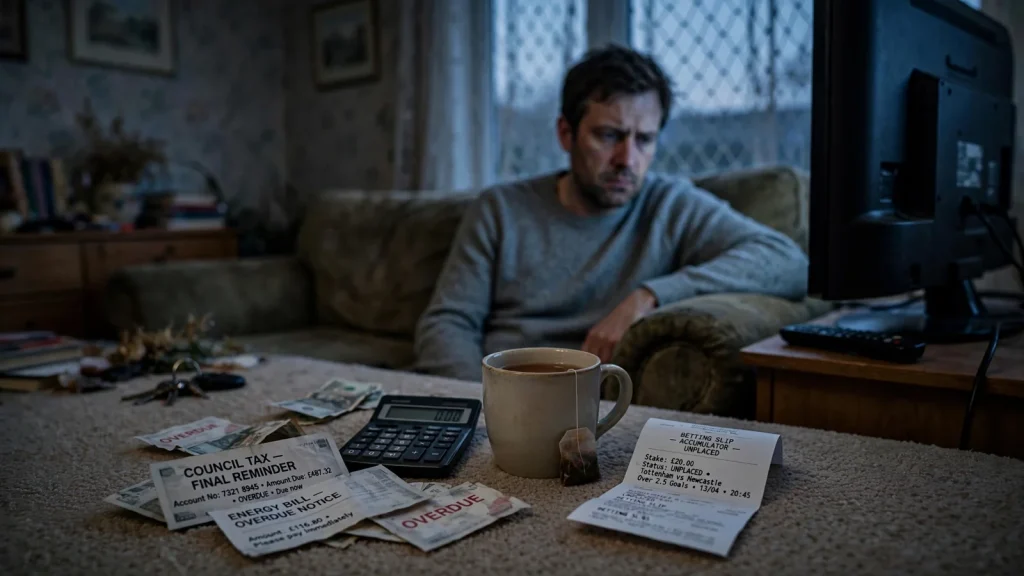
Gambling carries financial risk, and oversight is not insurance. Players should wager only what they can afford to lose.
That framework is the background to any search for Crazy Time online casinos in Great Britain. It explains why the relevant question is not simply where a company is based, but whether the remote gambling it offers falls within the British regulatory system. The Commission supplies that system’s central authority. The practical steps involved in assessing a particular casino are another matter.
Gambling still carries financial risk, even where an operator is regulated. Players should wager only what they can afford to lose. Oversight is not insurance.
Live Casino Games, and the People Around the Table
A live casino occupies an unusual space between a game room and a broadcast studio. The table is physical; the audience is dispersed. A dealer or presenter appears on screen, while cameras carry the room into private homes and the software records wagers and displays the game. The social setting is real enough to have people in it, yet carefully framed: the table, the host and the action are made visible, while the rest of the studio stays out of view.
That arrangement is older than Crazy Time. Card tables and roulette wheels were among the first familiar sights of the live-casino format, bringing recognisable casino games into an online setting without turning them into ordinary computer animations. Grosvenor introduced its live casino games in 2013, with Blackjack, Texas Hold’em and Roulette among the offerings. The menu joined long-established table games to a newer way of watching them: through a camera, with a presenter on the other side of the screen.
The human presence matters. In a digital game, the action can feel like a sequence of prompts and outcomes. A live table instead has a dealer handling cards or a wheel, a host speaking to the camera, and a setting that implies a shared occasion. The player is not sitting at the same table, but the broadcast gives the session a centre. The machinery is still there, of course: software connects the screen to the game and registers the wager. The impression of company and the underlying system coexist without much fuss.
Crash Casino Games in the UK: How They Fit In
Providers help shape that environment. Evolution is a game provider associated with live casino content, while NetEnt and Eyecon are also names found across casino gaming. A provider is not the casino itself: it creates games that may appear within an operator’s wider catalogue. That distinction is easy to miss when everything is presented within one website, but it explains why a live game can retain its own visual identity while sitting beside products from other studios.
Crazy Time belongs to this wider live-casino world, though it is not simply another card table with a dealer. Its name is often sought alongside phrases such as “Crazy Time online casino UK” or “online casino with Crazy Time”; in ordinary terms, the interest is in a live casino setting that includes the game. The surrounding environment gives it context: a hosted broadcast, a production team behind the camera, and a catalogue where live tables share space with other kinds of casino entertainment. The game itself has a distinct identity, but the live format is part of what makes it recognisable.
There is a small social theatre in these rooms. The dealer’s gestures and the presenter’s commentary are not merely decoration; they make a remote session legible as an event. In traditional casinos, the table is a place where strangers can observe one another, even when they do not speak. Online, that public room is reduced to a screen, yet the visible host preserves some trace of the gathering. It is a carefully managed sociability: present enough to distinguish live play from an isolated interface, bounded enough to remain a broadcast.
The difference between formats also says something about what players expect from a casino. A card game foregrounds procedure and the person dealing; a roulette table centres the wheel and its attendant pause; a show-led game places greater emphasis on presentation. These are not just different rules, but different ways of staging attention. Live casinos package them together, inviting movement between a quiet table and a more theatrical screen without making them the same experience.
UK Casino Dice Games: Odds, Slots and Licensing
This is why the people around the table deserve notice, even when the software remains in control of the session. Dealers, presenters and production staff turn a digital product into something watched as well as played. They cannot make chance predictable, nor should their presence be mistaken for a personal relationship. They are workers in a designed environment, doing the visible part of a system that also depends on cameras, interfaces and studio operations. A polished room, but still a room built for gambling.
Any such setting carries the same practical boundary: only money that can be afforded to lose belongs in a gambling session. The atmosphere may be social, polished and lively; the wager remains financial, and the screen does not soften that fact.
Choosing a Casino Without Trusting the Sales Pitch
A casino’s presentation can make a game feel like the main event; its licence is the more consequential detail. For a Crazy Time casino in the UK, the first check is whether the business offering play to people in Great Britain holds the relevant UK Gambling Commission licence. The operator’s location does not remove that requirement. A polished site, familiar branding or prominent game tile is not a substitute.
The Commission’s public register provides a practical way to check. Before depositing, find the operator’s licence number and verify it there. Then compare the registered business details with the name and website shown by the casino. A licence belonging to a similarly named company is not proof that the site itself is covered. Nor is a logo in a footer: it is a claim made by the operator, not the independent check.
That small act of comparison matters because casino brands and corporate names do not always line up neatly. The company named in legal information may differ from the name on the homepage, while several domains can look alike. The point is not to decode every corporate relationship, but to make sure the licence record corresponds to the business and service actually being assessed. If the connection cannot be established, the sales language has done its work without answering the useful question.
Verifying a Licence
Find the licence number
Locate the operator’s licence number on their website.
Check the public register
Verify the number using the UK Gambling Commission’s public register.
Compare business details
Ensure the registered business name and website match the details shown by the casino.
What a “best” casino can mean
People looking for the best Crazy Time casino UK option may be comparing game access, design, promotions or reputation. Those are different questions from whether the operator is authorised to serve the market. A claim that a site is among the best Crazy Time casino sites says little about its regulatory status unless it can be checked against the register.
Licensing is a threshold, not a medal. It does not establish that every feature will suit every player, and it does not turn promotional copy into neutral advice. Once the licence is verified, other details can be assessed on their own terms. Keeping those judgements separate makes it harder for a bonus banner or a list of supposed favourites to stand in for basic due diligence.
The same distinction applies to Crazy Time casino bonuses. A promotion may look generous on its own terms, but its presence cannot confirm that the company offering it has the required licence. Bonus conditions belong to the offer; authorisation belongs to the operator. Conflating the two is convenient for marketing. It is not a check.
Results are not credentials
A page displaying Crazy Time results, or a casino result for the game, also says nothing by itself about who is legally responsible for the service. Game information and operator credentials answer separate questions. Searchable results, promotional rankings and claims about strategies can all appear authoritative while leaving the licensing issue untouched.
Nor does a persuasive account of past results establish what will happen in a future session. That question is separate from choosing an operator, and a record of outcomes is not evidence of regulatory approval. The useful order is simple: establish who runs the casino and whether that operator is licensed for Great Britain, then consider the site’s other claims without treating them as proof of the first.
A sensible assessment is therefore less about finding a crowned winner than checking a concrete record. Verify the licence number on the UK Gambling Commission register before making a deposit, and do not rely on a badge or an endorsement alone. Gambling should be limited to money that can be afforded to lose. The distinction is plain. Sales copy is not oversight.
Mines Casino Game UK: Demo, Rules and Risks
Where Crazy Time Fits in the Live Casino
A casino’s live lobby is not always arranged as one continuous floor. It may divide streamed games into familiar table categories, such as roulette and blackjack, while giving game-show titles their own shelf or grouping. Crazy Time can therefore be easy to overlook when someone scans only the traditional tables: its live presentation belongs to the casino catalogue, but it does not look like a conventional card or roulette table.
The clearest route is through the casino’s live-games area, then any available game-show category or title search. Labels differ between sites, and some lobbies place live titles together rather than separating them by format. A search for “Crazy Time” can be more direct than browsing a long sequence of tiles. If the title does not appear, that alone does not establish why; the catalogue may differ by operator, account access, or the way its games are organised.
This distinction matters because a casino’s general live offering is not proof that it carries every live title. Grosvenor, for instance, first introduced live casino games in 2013, with card and casino staples including Blackjack, Texas Hold’em and Roulette. That history shows how the live lobby grew from table-game conventions; it does not guarantee that a particular title will be present in a current catalogue. Availability is a property of the individual offering, not of the label “live casino”.
Once found, the game tile is usually the point of entry to its live interface. The lobby may display a preview, title, or other identifying information before the game opens, but the exact layout is a matter for the operator’s software. Some sites make the live section prominent; others place it behind a menu or alongside other casino formats. There is no single British lobby design, and a familiar-looking tile should not be mistaken for a sign that every casino offers the same experience.
Chicken Road Game in UK Casinos: What’s Known
For anyone trying to locate the Crazy Time wheel game, the useful distinction is between the game’s identity and its shelf position. “Live casino” describes the wider environment; a game-show label, if the site uses one, narrows the browse. The wheel in the title is not necessarily a clue to look under roulette: casino catalogues may sort by format rather than by the physical object shown on screen. Browsing the available categories, then checking the title itself, is less misleading than assuming a universal menu structure.
Access also begins with the ordinary boundary between browsing and gambling. A title may be visible before an account is funded, while playing for money requires an eligible, verified account with a properly licensed operator. Before depositing, the operator’s licence number should be checked on the Gambling Commission’s public register. A catalogue is not a credential.
The lobby can make a game feel like one item among many, framed by thumbnails and menus. Yet placement is only a convenience of presentation; it says nothing about what will happen in play or whether a particular casino is suitable. The sensible order is modest: identify the title, confirm the operator’s status, and understand what the on-screen entry leads to before committing funds. Only money affordable to lose should be wagered. That is the less theatrical part.
Recommended online casinos
- JetsetspinsBonus: 200% Bonus + 100 Free Spins + Free Royal Wheel · Payout speed: 1-3 business days
- ChanzeBonus: Slots Welcome Bonus #1 200% up to €500 · Payout speed: 1-3 business days
- SlotoSportBonus: 500% up to £ 10 200+ 777 FS · Payout speed: 1-3 business days
- SpinFormulaBonus: 550% Up To £15,000 + 550 FS · Payout speed: 1-3 business days
- EvoSpinBonus: 125% up to €2500 + 125 Free Spins · Payout speed: 1-3 business days
- ZombillionBonus: Welcome Pack 250% up to £4000 + 200 FS · Payout speed: 1-3 business days
Strategy, Chance and the Limits of Control
A Crazy Time casino strategy can shape the decisions around a game; it cannot make the game’s next result knowable. That distinction is easy to lose in a format built to hold attention. A sequence of outcomes looks like a story, and stories invite explanations: a run must be ending, a quiet spell must be due a change. But an apparent pattern is not a promise.
A betting system may prescribe how much to wager, when to stop or how to divide a balance among choices. Those are rules for the player’s conduct, not instructions to the game. Increasing a wager after a loss does not make a favourable result more likely; repeating a choice after a win does not secure another one. The arithmetic can be orderly while the outcome remains uncertain.
Do
- Set a firm spending ceiling
- Establish an end point before play
- Pause when chasing losses
Don’t
- Treat patterns as promises
- Rely on trackers for forecasts
- Use systems to recover losses
That is the boundary of a Crazy Time casino game strategy. A plan can limit the damage of an impulsive decision by setting a firm spending ceiling and an end point before play begins. It can also make it easier to leave after a loss, rather than treating the next wager as a means of recovering what has gone. The plan matters because attention narrows under pressure. The wheel keeps turning; the balance does not become less real.
Trackers present a more technical-looking version of the same temptation. A Crazy Time tracker may display or record past results, giving them a visible order that is useful for reviewing what has happened. A casino tracker for Crazy Time, however it is presented, has no power to turn that record into a forecast. Recent results describe the past. They do not give a player privileged access to the next one.
This is where a tracker can mislead without necessarily falsifying anything. A record may be accurate and still encourage a false inference. A long absence of a particular result can feel like evidence that it is “due”; several appearances in succession can seem to signal a continuing run. Neither feeling changes the uncertainty of a future outcome. The display lends coincidence the sober appearance of data.
The same caution applies to systems advertised as clever, disciplined or mathematical. A method can be tested against a chosen stretch of past results and appear convincing, especially when the stretch is selected after the fact. That is not proof that it will work in later play. Nor does a tracker become a strategy simply because it supplies a chart. Information about previous outcomes is not control over future ones.
JetX Casino Game in the UK: How It Works
The more practical question is therefore not which pattern to follow, but what role the game is allowed to occupy. A pre-set limit can keep entertainment from quietly becoming an attempt to repair a disappointing evening. Pausing when attention turns to chasing losses is a meaningful decision, not a failure to find the right system. No method removes the risk of losing money.
A sensible approach leaves room for chance rather than pretending to tame it. Wager only what can be afforded to lose. That is the part a strategy can actually govern.
Crazy Time as a Live Game-Show Format
Crazy Time takes the visual language of a television game show and places it inside a live casino setting. Its defining image is a large, brightly coloured wheel, with a presenter guiding the event as it unfolds. The result is less like watching a quiet card table and more like joining a studio spectacle: colour, sound and an on-screen host give each round a sense of occasion.
That presentation is central to the game’s identity. In a conventional game-show broadcast, the audience watches contestants pursue a prize. In Crazy Time, the casino format gives the viewer a stake in the outcome, while the presenter supplies the familiar cues of a hosted show: anticipation before a result, a reaction when it arrives, and a change of pace when a feature begins. The performance is part of the product, not merely decoration around it.
The wheel makes the basic action easy to follow. A round builds towards its result as it turns, and the game’s bonus features shift the scene away from the main wheel into more elaborate, game-show-style sequences. Those changes of setting help explain why Crazy Time can feel more theatrical than a standard live table game. The format depends on movement and reveal: the show keeps the eye busy while the outcome remains uncertain.
Live Dream Catcher Casino UK: What to Check
That distinction matters. Spectacle can make a casino game feel social, even when play is mediated by a screen. A presenter creates a point of human contact; a lively studio atmosphere can make a solitary activity resemble a shared event. Yet the show does not turn chance into a contest of skill, nor does a dramatic pause signal that an outcome is due. It is entertainment wrapped around gambling, with the suspense doing much of the emotional work.
The game also reflects a wider change in how casinos present themselves. Live formats borrow the staging of television, then adapt it to a setting where viewers can place wagers as events happen. In Britain, Grosvenor’s launch of live casino games in 2013 included established card and casino formats such as Blackjack, Texas Hold’em and Roulette. Crazy Time belongs to a later, more overtly show-led style of presentation: less an attempt to reproduce a traditional table, more a purpose-built spectacle.
For some, that theatricality is the attraction; for others, it may feel busier than the measured rhythm of a dealer-led table. Neither reaction changes the underlying distinction between the programme and the wager. The host can entertain, the wheel can command attention, and the bonus scenes can add variety, but none of those elements makes the result controllable.
A sensible boundary remains necessary. Gambling carries the possibility of loss, even when it arrives in the language of a brightly lit show. Only wager what can be afforded to lose. That is the plain part.
Free Play and the Difference Between Practice and Gambling
A free version of Crazy Time can sound like a small change in wording, but it marks a different relationship with the game. In a free-play setting, no money is staked and a result does not produce a cash win. The screen may still resemble a live casino game, yet the financial consequence has been removed. That makes it useful for seeing how the format feels, not for testing what would happen with money at stake.
Availability is not universal. A search for Crazy Time free play may lead to pages that describe a demo, a promotional offer or simply the game itself; those are not interchangeable. Nor should the phrase “free spins” be taken to mean that a live game-show format necessarily has a spin-based free mode. The name of an offer is not proof of what it includes. A casino review can describe an operator or its terms, but a review alone cannot establish that a free version is available at a particular site.
Practice has limits. It can make the pace and presentation more familiar, but it cannot reproduce the pressure of wagering money or promise that real-money outcomes will follow the same pattern. A free round is not a forecast. That distinction matters especially where the bright, social surface of a game makes it feel less like a financial decision than it is.
Real-money play changes the stakes in the plainest sense: money can be lost. In Great Britain, online gambling is legal at sites licensed by the UK Gambling Commission, and the licence number should be checked on the Commission’s public register before depositing. That check concerns the operator, not whether a game offers a free mode or whether a particular session will be safe from loss. No licence turns chance into certainty.
Free access should therefore be treated as a way to become acquainted with a game, where it is offered, rather than as a substitute for judgement about gambling. A promotional label does not erase the difference between practice and play for money, and a free mode should not be assumed to exist at every casino. The sensible boundary remains simple: only gamble what can be afforded to lose.
Deposits, Bonuses and the Rules Behind an Account
A Crazy Time casino bonus is an offer attached to an account, not a feature of the game itself. Welcome offers, deposit bonuses and promotions described as no-deposit offers can all carry separate terms. The label says little about whether Crazy Time qualifies: eligibility, contribution rules, expiry conditions and withdrawal restrictions need to be read in the offer’s own wording before money is deposited.
A no-deposit bonus is not a promise of cash that can be withdrawn without conditions. Any promotion may limit how its funds or winnings can be used, and the distinction between bonus balance and withdrawable balance matters when considering casino payouts. The terms should make clear what actions are required and what happens if the offer is declined or removed. If the conditions are unclear, the apparent value is not a reliable guide.
For customers in Great Britain, the account sits within a regulated system. Remote gambling operators serving the market must hold the relevant Gambling Commission licence. The Commission issues operating licences to businesses and personal licences to individuals who work in regulated roles. Before depositing, the operator’s licence number should be checked against the Commission’s public register, rather than accepted on the strength of a logo or promotional claim.
The account process also has practical safeguards. Operators must verify a customer’s age before allowing a deposit, and new customers must be prompted to set a financial limit before their first deposit, with account-level limit controls available. Credit cards cannot be used for gambling, including through a money service business; a wallet funded by credit card cannot be used for gambling either. These restrictions are part of the payment framework, not quirks of a particular bonus.
“Not on GamStop” is not a bonus category or a special route to a Crazy Time offer. GAMSTOP is a self-exclusion programme, while UK-licensed casinos must provide self-exclusion tools of their own. A site’s claim about exclusion status does not replace the need to establish whether it is licensed for Great Britain.
Bonuses can make an account look more generous. The terms and the safeguards behind it matter more. Gambling should be limited to money that can be afforded to lose.
Rules, Roulette and the Great Britain Slot-Stake Limits
Crazy Time’s rules, multipliers and displayed scores describe how a round works; they do not, by themselves, establish how much may be staked. A multiplier is part of the game’s calculation, while a stake limit is a separate regulatory question. Treating the two as interchangeable makes the screen look more legally informative than it is.
A specialist casino review describes Great Britain’s online-slot limits as £5 per game cycle for adults aged 25 and over, and £2 for adults aged 18 to 24. The same review says those limits do not cover roulette or blackjack. Its distinction matters: casino games may share a lobby without sharing the same regulatory category. A roulette table is not a slot merely because it appears beside one; nor does the presence of a multiplier settle the classification of another game.
That is why the figures should not be carried across to Crazy Time by assumption. The game’s own rules determine what a wager can return under its outcomes; the relevant stake treatment depends on the category the game falls into. A game-show presentation does not answer that question, and a score or multiplier is not a statement of the permitted stake.
For a player, these are different checks: understand the rules and payout language of the game, then distinguish those from any limit applicable to its category. The figures cited above concern online slots, not roulette or blackjack. They should not be treated as a universal casino-game cap.
The arithmetic is only part of the picture. A multiplier can magnify a result, not make an outcome predictable or turn a wager into income. Any play should remain within money that can be lost without affecting essentials. That is the less theatrical rule.
What a Crazy Time Demo Can—and Cannot—Show
A Crazy Time demo, where one is offered, can provide a low-pressure view of the game’s presentation: its on-screen layout, pacing and the way a round moves from one stage to another. That can help make the format less unfamiliar before any decision about playing for money. It is an introduction, not a forecast.
The distinction matters because a demo cannot establish what a future real-money round will produce. A run of outcomes seen in practice does not reveal a pattern to rely on, nor does it promise that paid play will feel the same. The demonstration may resemble the live game visually, but resemblance is not evidence of a shared result or a dependable advantage.
Labels such as “Crazy Time slot demo” can also be misleading. The word “slot” may appear in informal descriptions, but it does not turn the game into an online slot or make a demo a guide to slot rules. The useful question is narrower: does the available demonstration make the game’s screen and sequence easier to understand?
Access should not be assumed. A casino’s catalogue may or may not include a demo, and the presence of one says nothing by itself about the quality of an operator or the likely experience with money at stake. Any decision to move beyond demonstration belongs to a different category of choice.
Practice can reduce unfamiliarity. It cannot remove chance. Real-money gambling should remain limited to money that can be afforded to lose.
What are the online slot stake limits in Great Britain?
The maximum stake is £5 per game cycle for adults aged 25 and over, and £2 for adults aged 18 to 24. These limits do not apply to roulette or blackjack.
Are online casino games licensed and regulated?
Yes. The UK Gambling Commission regulates online gambling in Great Britain, and remote operators serving consumers there must hold the relevant licence.
Is LuckyPays licensed by the UK Gambling Commission?
The Commission’s public register dated 26 September 2026 has no LuckyPays entry under the brand or the stated domain, luckypays.io.
Related posts

Terms of Use
Responsible Gambling