
Monopoly Live Casino UK: How the Game-Show Format Works
 Available in GB
Contents
The game combines a casino setting with a television-style studio, so its format and the limits of results tracking deserve separate attention.
Monopoly Live in the UK: A Game-Show Format in a Casino
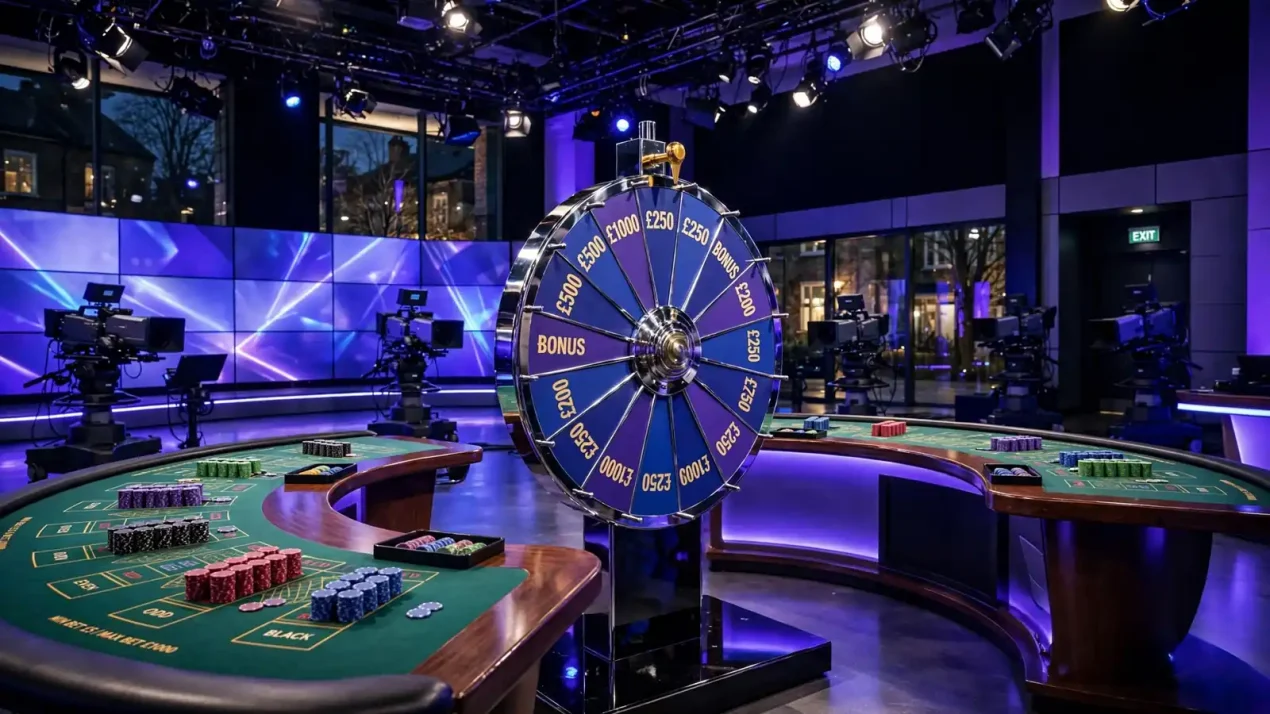
Monopoly Live sits at an unusual junction: it belongs to the casino, but borrows the visual language of a television game show. Its appeal is not simply that a familiar board-game name has been placed beside casino play. The format asks for a different kind of attention from the one demanded by a conventional live table. A roulette table invites close interest in the wheel, the ball and the wager. A game-show presentation makes the studio itself part of the spectacle.
That distinction matters in the UK, where “live casino” can describe quite different experiences. At one end are familiar table games, presented with a dealer and a surface organised around cards, chips or a wheel. At the other are more theatrical productions, where the studio, host and show-like pacing give the game a public performance quality. Monopoly Live casino belongs to the latter broad category. Its title signals the cultural reference; its presentation sets it apart from a quiet virtual table.
Online Bingo UK: How Bingo and Casino Games Connect
The word “live” can make these formats sound more alike than they are. In a conventional table game, the dealer’s actions and the game’s equipment form the centre of attention. In a show-style production, the host may carry more of the atmosphere, and the set can feel designed for viewing as well as play. The result is still casino entertainment, not merely a programme to watch. But its emotional grammar is closer to a studio show than to the restrained ritual of a card table.
There is a small social history behind that change. Casino games have long depended on more than their rules: the room, the dealer’s manner, the ceremony around a wager and the company of other players all help make an occasion. Online live casino recasts some of that theatre for a screen. It can preserve the visible presence of a human host while removing the shared room. The player is at a distance; the performance is close at hand. A curious compromise.
In Britain, this development belongs to a wider online-casino story, rather than to Monopoly Live alone. Grosvenor first introduced its live casino games in 2013, with offerings that included Blackjack, Texas Hold’em and Roulette. That early range shows how the live format initially carried recognisable casino tables into an online setting. It does not make every later live title a table game. The category grew to include presentations that use spectacle and familiar entertainment imagery as part of their identity.
Online Casino Without ID in the UK: What It Means
Monopoly Live casino UK searches often reflect that mixture of expectations. Some people may be looking for the comfort of a known board-game world; others may be drawn to the live studio, or simply want to understand where the title fits among casino games. The name can suggest a direct translation of the board game, yet the useful starting point is less literal: this is a casino game presented through a game-show frame. Familiar imagery supplies a point of recognition, while the live production supplies its own atmosphere.
That framing also explains why “casino” and “game show” are not competing descriptions. The first identifies the setting and purpose; the second describes the mode of presentation. A studio host does not turn a casino game into ordinary television, just as a camera does not make a roulette table cease to be a roulette table. The boundary is cultural as much as visual. One format foregrounds the mechanics of a table; another foregrounds a staged event.
The live format can make online play feel less abstract than a screen of buttons and symbols. Human presence, speech and set design give the experience texture. Yet atmosphere should not be mistaken for evidence about how a game works or what any particular outcome means. Presentation can make an event feel personal; the wager remains a financial decision. The theatre is real, but it is theatre.
For UK audiences, Monopoly Live therefore represents a change in the casino’s familiar scenery. The old table has not disappeared; it has acquired neighbours with brighter sets and more conspicuous showmanship. The appeal is partly recognition and partly contrast: a known cultural motif placed inside a modern live-casino production. The format asks to be watched as well as played, without ceasing to be gambling.
That distinction is worth keeping in view. A lively set can soften the visual austerity of online gambling, but it cannot soften the consequences of a wager. Gambling should be limited to money that can be afforded to lose. The show may be colourful. The decision is still consequential.
Gambling Risk
Gambling should be limited to money that can be afforded to lose. The colourful presentation of a game show does not soften the financial consequences of a wager.
Recommended online casinos
- JetsetspinsBonus: 200% Bonus + 100 Free Spins + Free Royal Wheel · Payout speed: 1-3 business days
- ChanzeBonus: Slots Welcome Bonus #1 200% up to €500 · Payout speed: 1-3 business days
- SlotoSportBonus: 500% up to £ 10 200+ 777 FS · Payout speed: 1-3 business days
- SpinFormulaBonus: 550% Up To £15,000 + 550 FS · Payout speed: 1-3 business days
- EvoSpinBonus: 125% up to €2500 + 125 Free Spins · Payout speed: 1-3 business days
- ZombillionBonus: Welcome Pack 250% up to £4000 + 200 FS · Payout speed: 1-3 business days
Playing Online: The Rules Around the Screen
Playing Monopoly Live online takes place inside a gambling account, not in a space beyond the usual rules. The screen may make the experience feel self-contained, but the account around it carries obligations about age, money and access. These safeguards are part of the setting in which online casino play happens in Britain.
Age is checked before an operator lets a customer deposit funds. An account is therefore not simply opened by entering details and moving straight to play: the operator must establish that the customer is old enough. Online gambling is legal for adults aged eighteen and over when it takes place through an appropriately licensed operator. That threshold is a condition of access, not a suggestion to be revisited after a first wager.
Money controls are built into the account as well. Remote operators must prompt new customers to set a financial limit before their first deposit and make account-level limit controls accessible. These measures can put a boundary around deposits or other spending, although a limit is useful only if it reflects what can genuinely be lost without affecting essentials. Gambling should be confined to money a person can afford to lose. The phrase is plain; the arithmetic behind it is not always so.
Payment rules also shape the route from bank account to casino balance. Remote gambling operators cannot accept credit-card payments for gambling, including credit-card funding passed through a money service business. Nor can they accept wallet payments when that wallet permits credit-card funds to be used for gambling. A familiar payment brand does not change the source of the money or the restriction attached to it.
Mines Casino Game UK: Demo, Rules and Risks
Some protections apply specifically to online slots. A specialist review reports Great Britain’s stake limits as £5 per game cycle for adults aged twenty-five and over, and £2 for adults aged eighteen to twenty-four; those figures should be understood as the review’s account of the rules, rather than treated as a timeless description of every casino game. The same distinction matters when a live title appears beside slots in a casino lobby: the limits described for slots do not apply to roulette or blackjack. The game’s presentation alone does not settle which category a rule concerns.
Slot mechanics are constrained in other ways. Autoplay is prohibited for online slots in Britain, and a new spin cannot begin until at least two and a half seconds have elapsed from the start of the preceding game cycle. These requirements interrupt the rapid, automated rhythm that some digital products once encouraged. They do not make gambling harmless; they set boundaries around how the product can operate.
Account protections extend beyond the moment of play. UK-licensed casinos must provide responsible-gambling tools, including self-exclusion, so an account can be restricted or closed when continued access is no longer wanted. Operators must also offer an internal complaints process and access to an approved Alternative Dispute Resolution service. These routes matter because an online account is both a place to play and a record of transactions, decisions and disputes.
For anyone considering Monopoly Live online, the practical point is that the game sits within this wider structure: checks before deposits, limits and payment restrictions, and account tools intended to make activity more controllable. None turns a wager into a safe source of income. The screen remains persuasive; the balance remains real.
Do
- Set a financial limit before your first deposit
- Use responsible-gambling tools like self-exclusion
- Verify that the operator is licensed for remote casino gambling
Don’t
- Use credit cards to fund your gambling account
- Treat gambling as a safe source of income
- Ignore the distinction between slot limits and table games
Casino Sites and the Licence Behind the Lobby
A lobby can look orderly and still tell little about the legal status of the business behind it. A title such as Monopoly Live may appear beside familiar table games, but its presence is not evidence that the site is authorised to offer gambling to people in Great Britain. The relevant question is who operates the service, and whether that business holds the required licence.
The UK Gambling Commission regulates commercial gambling in Great Britain and is the sole regulator for it. Its oversight covers remote gambling offered to people in Great Britain even when the operator’s key equipment is located elsewhere. A company cannot step outside the British licensing system simply by placing its servers abroad. Geography is not a loophole.
The Commission issues operating licences to businesses and personal licences to individuals working in regulated roles. These are not interchangeable credentials: the operating licence concerns the business offering gambling, while personal licences apply to people carrying out specified functions. When checking a casino, the central task is to establish that the actual operator—not merely a game supplier, payment service or similarly named business—is licensed for the relevant activity.
The Commission’s public register is the place to check. Search for the operator’s legal name and compare the register entry with the company details given on the casino site. A brand name may differ from the company name, so the site’s terms and conditions can help identify the legal entity responsible for the account. Then check that the licence is current and covers remote casino gambling. A logo or a claim in a footer is not a substitute for an entry in the regulator’s register.
Keno Casinos in the UK: What to Check Before Playing
That distinction matters for people comparing casinos with Monopoly Live. A site may advertise the game, or display a licence belonging to an associated company, without making clear which entity accepts the customer’s wagers. The operator’s identity should be consistent across the register, account terms and other legal information. If those details do not match, the apparent reassurance of a badge has little weight.
Licensing also creates a route for accountability. A regulated operator must provide an internal complaints process and access to an approved Alternative Dispute Resolution service. The Commission’s role is wider than settling an individual disagreement: it licenses businesses and relevant individuals, and oversees the regulated market. A complaint route does not promise a particular outcome, but it is part of the structure that distinguishes a licensed service from one operating outside that system.
The law is not confined to companies incorporated in Britain. Remote operators serving Great Britain consumers need the appropriate Gambling Commission licence regardless of where they are based. That is why an overseas address, a foreign authorisation or a polished English-language site cannot replace the British licence. Offshore casinos sit outside the UKGC system; they do not become locally regulated by welcoming British visitors.
Claims about the best Monopoly Live casinos are therefore less useful than a clear account of the operator and its authorisation. A review can describe a lobby, but only the regulator’s register can establish whether a business holds a Commission licence. Before depositing, verify the licence number on the public register and make sure it belongs to the operator named in the site’s terms. If the identity cannot be followed from one to the other, pause. The detail matters.
Verifying an Operator
Check the Public Register
Search for the operator’s legal name on the UK Gambling Commission’s public register.
Compare the Details
Match the register entry with the company details provided in the casino’s terms and conditions.
Confirm the Licence
Ensure the licence is current and specifically covers remote casino gambling.
Playing the Game Without Mistaking It for a Slot
The word “game” covers several different things in a casino lobby. A title may borrow the look of a television show, use a wheel or other familiar device, and still need to be understood through its formal gambling category. That category matters because British rules do not treat every casino game as an online slot. Presentation is not classification.
For anyone asking how to play Monopoly Live, the responsible starting point is therefore modest: the title alone cannot establish which rules apply. Its format may invite comparison with a slot, roulette or a studio game, but resemblance is not enough to settle the regulatory question. The game’s own description and the operator’s classification are the relevant places to look. A lobby label is informative, not a substitute for the rules.
This distinction has practical consequences. Britain’s specific online slot stake restrictions attach to games that fall within the slot category, not to every game that happens to include a wheel, a multiplier or a dramatic reveal. A specialist review describes the limits as £5 per game cycle for adults aged 25 and over and £2 for those aged 18 to 24. The same review distinguishes roulette and blackjack from slots: those slot limits do not apply to either table-game category. That is a category boundary, not a general statement that every form of wagering is unrestricted.
The point is especially easy to miss when a casino game is designed as entertainment. A wheel can suggest roulette without being roulette; a prize reveal can look like a slot feature without proving that the underlying product is a slot. Conversely, an animated set and a host do not remove the need to apply rules that belong to the game’s formal category. The visual language is theatrical. The classification is consequential.
Plinko Casino UK: Games and 2026 Rules
For online slots in Britain, autoplay is banned, and a new spin cannot begin until at least two and a half seconds have elapsed from the start of the previous game cycle. Those requirements belong to the slot framework. They should not be carried over automatically to roulette or blackjack, nor should they be assumed to describe Monopoly Live without establishing that it is regulated as a slot. A similar-looking screen does not make the rules interchangeable.
This is why a careful explanation of how the game works should separate its visible sequence from the legal category. Instructions may describe what a player selects, how a round proceeds and how a result is displayed. They cannot, merely by describing those actions, prove that slot-specific restrictions apply. Nor does calling something a live casino game answer the classification question by itself.
The distinction also discourages a common shortcut: treating every game with a wheel as roulette. Roulette has its own recognised table-game identity; a wheel used in another format does not automatically inherit it. The same caution applies to blackjack, whose rules and structure are not defined by sharing a casino screen with other products. Categories are not costumes.
For British players, then, the useful question is not simply whether Monopoly Live feels like a slot. It is how the operator identifies the game and which regulatory rules follow from that classification. Where the category is unclear, confidence should stop at the boundary of what the description establishes. A polished interface can make games look alike. The rulebook has other ideas.
Online Slot Restrictions
In Great Britain, online slots have stake limits of £5 for adults aged 25+ and £2 for those aged 18–24, and prohibit the use of autoplay.
Results, Randomness and the Limits of a Tracker
A record of past results can answer a modest question: what was recorded before? It cannot, by itself, answer the more ambitious one: what will happen next? That distinction matters whenever a game is discussed through result pages, tracking sheets or claims of a system hidden in a sequence.
A tracker is an arrangement for keeping records. It may make outcomes easier to scan than a long history displayed on a screen, but presentation does not add predictive power. A run of similar results can look meaningful when set in columns or marked with colours. The pattern is real as a description of what has already been written down; the forecast is another matter.
This is a familiar human habit. People notice repetitions, gaps and apparent turns, then give them a story. In a game based on chance, a sequence can appear to be gathering momentum even when each new outcome is not obliged to continue, correct or complete what came before. A past result is evidence of a past event, not a promise about the next one.
That does not make records useless. They can help someone check what they saw, compare an account of an outcome with a displayed record, or keep play from dissolving into vague memory. But a log has to be understood for what it is: an archive, not an instrument that reaches forward. The neatness of a chart can lend an unsupported theory the air of measurement.
The same caution applies to claims about a “best” way to approach Monopoly Live. A result list cannot establish that one betting pattern is superior, and a tracker cannot turn a hunch into a strategy merely by preserving it. Without a sound basis for linking recorded history to future outcomes, apparent streaks remain descriptions, not instructions. Confidence is not a method.
There is also a difference between a result and an interpretation of it. The result is the event recorded; interpretation begins when someone says that it signals a trend, a correction or an especially favourable moment. Those claims may be more compelling when accompanied by tables and confident language, but their format does not settle whether the reasoning holds. A spreadsheet is not an oracle.
The word “randomness” is often used as though it meant that outcomes must look evenly mixed over a short stretch. It does not. Chance can produce clusters and awkward-looking runs, just as it can produce sequences that seem orderly. Human observers tend to treat the first as a warning and the second as a clue. Neither appearance, on its own, establishes what comes next.
Result searches can still serve a practical purpose when they are treated as requests for information rather than forecasts. A record may document what happened at a particular time or help clarify a disputed account. It should not be confused with a guarantee, a verified advantage or a reliable way to choose a wager. The distinction is less exciting than a secret pattern. It is also more useful.
Any tracker should therefore be judged by what it actually records and how carefully that record is maintained, not by promises attached to it. Missing entries, inconsistent labels or selective examples can make a history look more persuasive than it is. Even a complete and accurate record would describe the past; accuracy in recording is not the same as power to predict.
Attention A record of past results is an archive of what has happened and does not provide predictive power for future outcomes.
The temptation is understandable: a visible sequence feels as if it ought to yield a rule. But recording and forecasting are different tasks. Monopoly Live results can be discussed as past events without turning them into a map of future ones. Gambling should remain limited to money that can be afforded to lose.
The Live Casino Game Show in Its UK Setting
The phrase “game show” carries a different social history from “casino”. One suggests a public performance, governed by a host and a shared set of rules; the other suggests a private calculation between a player and the odds. A live casino title that borrows the first form does not erase the second. It places the act of wagering inside a scene designed to be watched as well as played.
That distinction helps explain the appeal of a Monopoly Live casino game. Its cultural shorthand comes from a board game associated with family tables, property deals and money made visible in brightly coloured pieces. The television-style setting recasts that familiar world as entertainment for an adult gambling audience. Recognition is part of the design’s language, not proof that the experience is equivalent to playing the board game. The old game belongs to a parlour; its casino adaptation belongs to a broadcast-like room.
Britain’s live casino history has a less theatrical starting point. Grosvenor first introduced its live casino games in 2013, with established card and casino offerings such as Blackjack, Texas Hold’em and Roulette. That milestone places live dealing within a UK casino setting before the game-show style became a conspicuous way to package play. The contrast is telling: cards and roulette bring their own inherited rituals, while a show format builds a stage around the game.
The later attraction of the live game show can be understood as a shift in emphasis. A conventional table gives attention to a dealer, a layout and decisions familiar to casino regulars. A show-led format makes the setting itself part of the event: a presenter, a camera-facing performance and visual cues can make the game legible to people who might not feel at home at a traditional table. The room is no longer merely a place where the rules are applied. It becomes a kind of theatre.
That does not make the format culturally neutral. A familiar property-themed world can soften the boundary between play and wagering, dressing a financial risk in colours and characters already associated with leisure. The borrowed familiarity is useful precisely because it asks for little introduction. The atmosphere may be playful; the underlying activity remains gambling.
Questions about how Monopoly Live works often arise from this collision of forms. The broad answer is that it presents casino play through the conventions of a hosted show, rather than asking the audience to regard it as an ordinary card table. That description captures the format, not every rule or feature. A review of the game should therefore distinguish its entertainment frame from claims about how often particular outcomes occur or what they might mean.
The British setting matters because live casino entertainment has developed as both gambling product and media performance. The show borrows the grammar of television, while the casino supplies the stakes. A neat arrangement.
Historical Context of UK Live Casinos
Grosvenor introduced live casino games in 2013, offering classics like Blackjack, Texas Hold’em, and Roulette before the more theatrical game-show formats became common.
What Statistics Can—and Cannot—Say About Monopoly Live
A statistic can look authoritative simply because it has been put in a table. For Monopoly Live, though, a figure is only useful when its origin, coverage and method are clear. A total without those details may describe a fragment of recorded play, or merely repeat a claim whose underlying records cannot be examined. Precision on the page is not the same as reliable evidence.
That distinction matters when considering Monopoly Live statistics. A collection of observations might describe what was entered into it; it cannot, by itself, establish that the collection is complete or representative. Nor does a past frequency show what should happen next. Turning a record into a strategy requires a further claim: that the recorded pattern has predictive value. That claim needs evidence of its own.
The same caution applies to a Monopoly Live tracker. A tracker can organise notes and make them easier to inspect. Its appearance may suggest a scientific instrument, but the label does not validate the information entered or the conclusions drawn from it. Without a dependable method and independently checkable records, a tracker is a notebook with a more confident name. It cannot make chance legible merely by arranging it in columns.
Strategy, in this setting, is often a word stretched to cover two different things. One meaning is a personal routine for deciding how long to play or how much to risk. Another is a system said to improve the likelihood of a particular outcome. The first is a matter of managing behaviour; the second needs proof that a repeatable advantage exists. A pattern noticed after the event does not supply that proof.
History invites a similar distinction. A convincing account of Monopoly Live’s past would need dated, attributable evidence tied to the game itself. General histories of live casino entertainment may explain the setting in which such products developed, but they do not automatically establish a particular title’s origin, milestones or changing mechanics. The distinction is modest, but important: background is not a substitute for a documented game history.
Searches for a strategy or a history often return confident summaries. Confidence is a feature of writing, not a test of truth. Useful scrutiny asks whether a statistic can be traced to records, whether the method is explained, and whether the conclusion goes beyond what those records support. Where those links are absent, restraint is more honest than a supposedly clever system.
None of this makes record-keeping worthless. It can help describe what someone has observed and keep personal impressions from blurring together. It simply cannot turn observation into prediction without evidence. Gambling remains uncertain, however persuasive a chart may appear. Only gamble with money that can be afforded to lose.
Finding a Site That Offers the Game
A casino’s page showing Monopoly Live establishes that the title is being advertised; it does not, by itself, establish that the business may accept real-money play from customers in Great Britain. Those are separate claims. The Commission’s requirement is that a remote operator serving people in Great Britain holds the appropriate licence.
The distinction matters because a familiar title, polished lobby or British-facing promotion can make a site look local without proving who runs it. Before depositing, the operator’s identity and licence number should be checked against the UK Gambling Commission’s public register. The name on the register should correspond to the business behind the site, not merely resemble the brand on a banner. A game listing is not a licence.
Before Depositing Funds
- Identify the legal entity operating the casino
- Find the operator’s licence number in the site’s small print
- Verify the licence number on the UK Gambling Commission register
- Confirm the register name matches the business behind the site
A specialist review of the public register reported that, on 26 September 2026, it found no entry for LuckyPays under that brand or the stated domain luckypays.io. Register information can change, so that dated observation is not a substitute for checking the current record. Nor should a promotional page be treated as evidence that an operator is authorised for the British market.
A Monopoly Live casino site is therefore best assessed in two stages: whether it presents the game, and whether the operator behind it is licensed to serve Great Britain. The first is a matter of the lobby; the second is a matter of public accountability. Before any deposit, the licence number belongs in the register, not just in the site’s small print.
A cautious distinction.
Demo Play: What Can Be Confirmed
A demo can make a casino game feel less like a purchase and more like a visit: the format can be sampled before money enters the picture. That distinction matters for a game presented as a live show, where the studio atmosphere may be as conspicuous as the wager itself. A free-to-try version, if offered, would let someone see how the on-screen experience feels without treating that first encounter as paid play.
But the phrase “Monopoly Live demo” does not, by itself, establish that a particular UK-facing casino provides one. Nor does the label settle what a demo includes, whether access requires an account, or whether its presentation matches the real-money version. Those details belong to the operator’s actual terms, not to the title’s name.
A demo is not evidence about the fairness or future behaviour of paid rounds. It may show the interface and the rhythm of play; it cannot turn an unpredictable result into a forecast. The neatness of a free version can also obscure a practical difference: money has not yet been put at risk.
In Britain, the rules for online gambling accounts and paid play remain relevant when gambling moves from a sample to real stakes. A screen that offers a trial does not remove the boundary between entertainment and financial risk. Free means no stake in that moment, not a promise about what follows.
Free Play and Review Claims, Without the Sales Pitch
A free version of Monopoly Live may sound like a way to see the game before committing money. But the phrase alone does not establish that a particular offer exists, what it includes, or whether access comes with conditions. Free access and a paid game are not interchangeable promises: a promotional label needs clear terms, while a review should say what was actually assessed.
The same caution applies to a Monopoly Live review. A confident verdict can be less useful than a precise account of its scope. Was the writer describing the presentation, explaining the rules, or evaluating a specific version? Without that distinction, “good” and “bad” are little more than decoration. A review cannot settle whether the game will suit every player, and a favourable description is not evidence of likely returns.
There is a small social theatre in the format: familiar property imagery, a host, and the ritual of a casino game arranged for an audience. That may be part of its appeal. It does not turn gambling into a harmless pastime, nor does an entertaining presentation change the financial nature of a wager. The sales pitch tends to blur those categories. The distinction matters.
Free-play wording should therefore be read as a claim to check, not as a guarantee of unrestricted access. Review language deserves the same treatment: useful when it identifies its basis, less so when it substitutes enthusiasm for evidence. Neither should be mistaken for a promise about what will happen during play.
A measured account can describe the experience without pretending to certify an offer or predict an outcome. That is less dramatic. It is also more honest. Any gambling should be limited to money that can be afforded to lose.
Are online casino games licensed and regulated?
Yes. The UK Gambling Commission regulates online gambling, and remote operators serving Great Britain must hold the relevant licence.
What are the online slot stake limits in Great Britain?
The limit is £5 per game cycle for adults aged 25 and over, and £2 for adults aged 18 to 24. These limits do not apply to roulette or blackjack.
Is LuckyPays licensed by the UK Gambling Commission?
The Commission’s public register dated 26 September 2026 does not show a LuckyPays entry under its brand or stated domain, including luckypays.io.
Related posts

Terms of Use

Responsible Gambling
