
Casinos That Accept USDC in the UK: What to Check
 Available in GB
Contents
A general crypto payment label does not confirm USDC; availability depends on the options shown in the casino’s payment flow.
USDC Availability Is a Cashier Question, Not a Promise
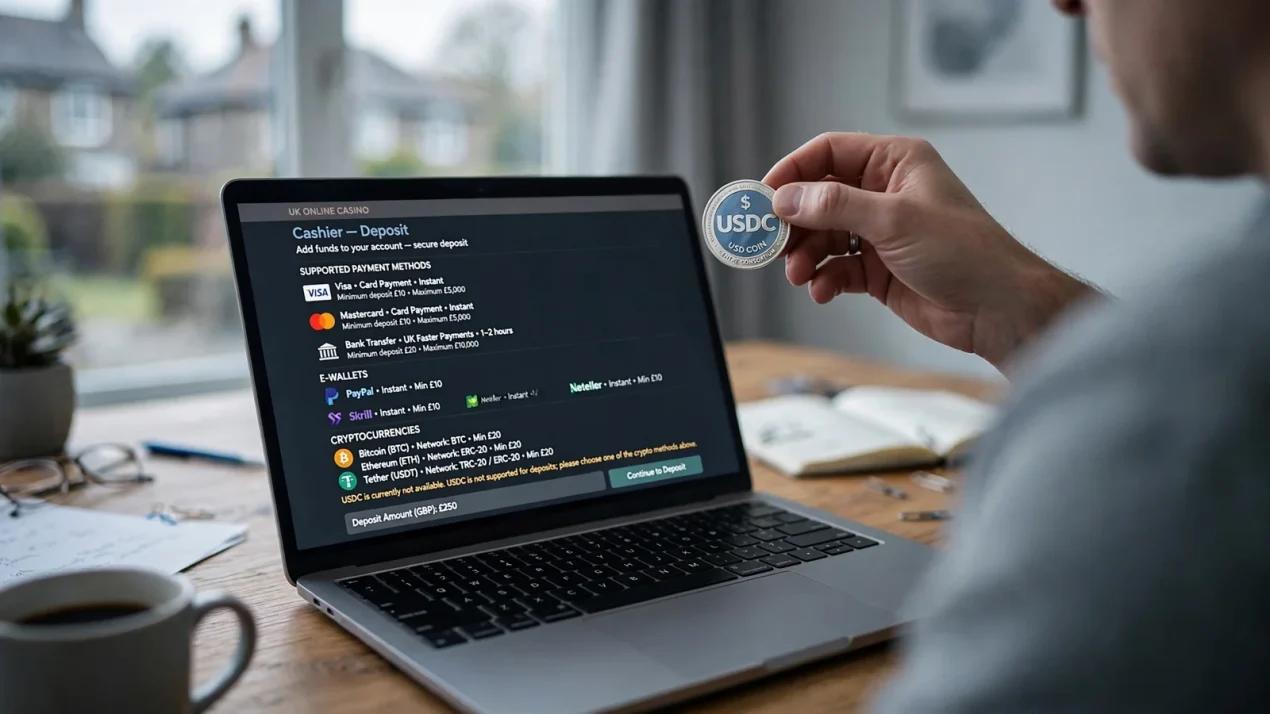
A casino can advertise cryptocurrency payments without accepting every digital currency. “Crypto” is a broad label, not a payment method with one universal set of assets behind it. A specialist casino review describes UK-facing sites listing Visa, Mastercard, bank transfer, e-wallets and several cryptocurrencies. That description does not establish that any particular site accepts USDC.
This distinction matters because a payment logo or a general reference to cryptocurrency can create a stronger impression than it warrants. A site may support a selection of coins, while another may use the same broad label for a different selection. USDC should therefore be treated as available only when it appears as a specific option in the casino’s own payment flow—not inferred from the presence of other cryptocurrencies.
The cashier is where a general claim becomes a practical one. Payment options shown there may depend on the account, the casino’s current arrangements and the stage of registration. A page describing crypto payments is not a substitute for seeing USDC named among the available deposit methods. Nor does a list of familiar payment brands answer the question: it describes categories and examples, not a confirmed USDC route.
Casinos That Accept E-Cheques in the UK: What to Check
That makes a definitive directory of every UK casino accepting USDC difficult to treat as reliable without current, site-specific confirmation. A list can look precise while resting on a loose use of the word “crypto”. It may also preserve an old payment description after an operator has changed what its cashier offers. The neatness of a table does not make its entries current.
There is a separate distinction between a casino being accessible to people in Britain and its payment menu being established. Remote gambling licensees serving Great Britain must hold the relevant UK Gambling Commission licence. That regulatory status is important, but it does not itself confirm that USDC is accepted. Licensing and payment availability answer different questions; one cannot stand in for the other.
The same caution applies to claims about the “best” or newest USDC casinos. A ranking is only useful if the underlying payment method has been confirmed at the relevant site. Without that, comparisons of games, bonuses or appearance leave the central point unresolved. A casino may be well known, newly launched or described as crypto-friendly and still offer no confirmed USDC option. Attractive labels do not settle cashier details.
Casinos That Accept Ukash in the UK: What’s Verifiable
For anyone comparing a UK-facing casino, the useful distinction is between a general mention of cryptocurrency and a named, selectable USDC method. The latter is the concrete indication to look for in the cashier and in the operator’s own payment terms. If USDC is not identified there, a broad crypto claim should not be read as confirmation. If it is listed, the casino’s accompanying terms still define how that route works.
This is not an argument that USDC cannot be accepted. It is a limit on what can responsibly be claimed about availability across UK casinos. A claim about one operator needs confirmation from that operator; it cannot be carried across to another site simply because both mention cryptocurrency. There is no single shared crypto menu.
The phrase “casinos that accept USDC in the UK” sounds like it should lead to a stable list. In practice, the answer belongs to each casino’s live cashier, not to the category label used in a review or advertisement. A broad description may help identify what to investigate, but it cannot replace the named payment option. The cashier is the test.
When USDC Is Not an Option: Familiar Deposit Routes
When a digital-currency option is not available, the familiar UK deposit routes are less exotic and easier to recognise: debit cards and bank-based payments. UK casinos commonly accept debit cards bearing the Visa or Mastercard name. Open banking and bank transfers are also described as deposit routes at many sites, though their operation is not identical. The ordinary currency of the cashier remains ordinary money.
A debit card makes the payment through a card network and the account linked to it. Visa and Mastercard are widely recognised brands, but a logo on a casino’s payment page is not a promise that every card product will work. The available options can depend on the site and the card itself, so the cashier is where the live choice becomes clear. This is a practical distinction, not a glamorous one. It matters.
Debit Cards
Commonly accept Visa or Mastercard brands. The available options depend on the site and the specific card.
Bank Transfers
Funds are sent directly from a bank account to the casino.
Open Banking
Connects a payment to a bank account through a digital authorisation process for potentially instant deposits.
Bank-based routes begin from a different place. A bank transfer sends money from a bank account, while an open banking service can connect a payment to that account through a digital authorisation process. A specialist review describes open banking and bank transfers as capable of providing instant deposits and fast withdrawals at many sites. That account is not a guarantee for every casino or every transaction; the cashier’s current options determine what is actually available.
The appeal of these routes is partly cultural. Cards and bank accounts are already woven into the routines of paying bills, buying goods and moving money between people. A casino deposit through one of them can feel like a familiar transaction placed in an unfamiliar setting. The payment method does not change what the money is for, but it can make the act of funding an account look deceptively ordinary. There is a reason to pause over that difference.
For someone comparing alternatives to USDC at online casinos in the UK, the useful comparison is therefore not simply “old money” against “new money”. It is between payment paths with different points of contact: a card issuer and card network on one side, a bank account and, where offered, an open banking service on the other. Neither label alone tells whether a particular deposit will be accepted. The operator’s cashier is the practical record of what it currently supports.
Casinos That Accept Boku in the UK: What to Know
This also explains why a payment method’s reputation can be less useful than its availability in a specific account. A route may be familiar across the wider market and still not appear at a given site. Conversely, a bank-based option may be presented under a service name rather than as a plain transfer. Names and interfaces differ; the underlying question is whether the route shown can be used for the intended deposit. The screen, rather than a general claim, settles that point.
A bank transfer and an open banking payment should not be treated as interchangeable merely because both involve a bank. One is a transfer from an account; the other is a way of authorising a payment through a digital connection. The distinction may be visible in the steps presented by the cashier. A card payment has its own familiar path. These are small procedural differences, but they shape what a player encounters before any funds move.
The wider attraction of bank-linked payments is straightforward: the money begins in an account already used for everyday finances. That familiarity can make the deposit route easier to identify than an unfamiliar digital asset. Yet a casino payment remains a separate decision from ordinary spending. A recognisable interface is not a measure of suitability, and a quick authorisation does not make the activity itself any less consequential. Convenience is not a verdict.
The alternatives are consequently modest in description, even if they are central in practice. Debit cards bearing Visa or Mastercard are common among UK casinos. Open banking and bank transfers are also routes identified at many sites, with a specialist review describing the possibility of instant deposits through them. Those statements describe broad availability, not a fixed menu shared by every operator. Payment pages change, and the cashier is the place where the available route can be confirmed.
A specialist review describes open banking and bank transfers as capable of providing instant deposits and fast withdrawals at many sites.
For UK players looking beyond USDC, these established methods offer a more recognisable starting point: card, bank transfer or open banking where presented. The choice is not a contest in which one method wins for everyone. It depends first on what the casino makes available and then on which route suits the account and the payment. The familiar options are not universal. They are simply the ones most likely to make sense before the cashier is opened.
Cards, Promotions and the Credit-Line Boundary
A card logo does not tell the whole story. Visa and Mastercard are widely used for debit-card deposits at UK casinos, but the relevant distinction is the kind of card account behind the payment. A debit card draws on money held in a bank account; a credit card draws on borrowed funds. They may share a network and look much alike in a wallet, but the rules treat them differently.
For UK-licensed remote gambling operators, credit-card payments for gambling have been prohibited since 14 April 2020. The ban remains in force. It is not a temporary cashier setting or a restriction that a casino can waive to make a deposit go through. A credit card therefore cannot be treated as an alternative to a debit card simply because both carry the same familiar brand.
Casinos That Accept Dogecoin in the UK: What to Check
That boundary matters when casino pages list card networks. A Visa or Mastercard logo alone does not establish that every card carrying it will work: the card product, the operator’s current cashier options and the payment’s eligibility all matter. The UK-facing sites considered in this context list those networks, but that is not a guarantee that a particular card will be accepted. Debit is the relevant category for card deposits; credit is not.
The distinction also guards against a mistaken inference about cryptocurrency. A casino accepting debit cards does not thereby accept USDC, and a card network’s presence says nothing about whether a crypto deposit route exists. Payment labels describe different parts of a transaction. A card deposit is not a stablecoin deposit under another name.
Promotions add a separate condition. A payment method can be available for depositing without being eligible for a particular bonus. The promotional terms, rather than the card logo, determine whether a deposit qualifies. This is one reason a bonus should not be treated as an automatic extra attached to every payment: the cashier and the offer’s conditions may not line up.
A specialist casino review has described PayPal as appealing for speed and convenience while noting that it may be excluded from bonus eligibility. That is a report about a particular kind of source, not a fixed rule for every operator or offer. Promotional terms change, and an exclusion attached to one payment route cannot safely be carried over to another casino. Debit-card eligibility should be checked against the offer itself, not inferred from a statement about PayPal.
Credit Card Ban
For UK-licensed remote gambling operators, credit-card payments for gambling have been prohibited since 14 April 2020.
This has a practical effect on how a deposit decision is assessed. The first question is whether the card is a permitted debit product and appears in the casino’s cashier. The next is whether using it meets the conditions of the promotion being considered. These are separate checks. A payment can be accepted while the associated deposit does not qualify for a bonus; equally, a bonus condition does not make a prohibited credit-card payment acceptable.
The credit-card rule reflects a wider judgement about gambling and borrowed money: access to a familiar financial tool is not considered sufficient reason to permit every use of it. The boundary is plain, even if card names and payment screens can make the distinction look less so. Logos are not the rule.
Mobile Slots and the Limits of the USDC Evidence
A slot game on a phone and a casino that takes USDC are separate propositions. One describes how a game is accessed; the other concerns how money reaches an account. A mobile-friendly site may offer slots without accepting a particular cryptocurrency, while a payment method’s appearance in a cashier says nothing by itself about which games can be played on a handset.
That distinction matters because the phrase “USDC mobile slots” can suggest a single product: a game, an app and a coin joined in one neat arrangement. In practice, those are different layers of an online casino. The game runs through the site or its software; the payment route is managed through the account cashier. Neither label establishes the other.
The British market adds a further boundary. Real-money gambling is legal only through operators holding the relevant UK Gambling Commission licence, and remote gambling licensees must verify a customer’s age before allowing a deposit. Those requirements concern the operator and account, not whether a slot happens to load on a phone. Mobile access is not a regulatory shortcut.
Casinos That Accept Upaycard in the UK
Nor does a cryptocurrency label establish that a particular slot can be funded with that currency. A casino might describe several digital currencies among its payment options, but that does not turn every title into a USDC game. The distinction is easy to lose in compressed marketing language, where “slots with USDC” can mean anything from a payment option at the casino to a claim about a specific game. Those are not interchangeable.
A useful way to read any mobile-USDC claim is to separate its parts. Is the casino available to customers in Britain under the required licence? Does its cashier actually display USDC for the relevant account? Does the game run through the mobile browser or an app? Each answer belongs to a different question. A familiar phone interface cannot confirm the payment method, and a listed payment method cannot confirm a game’s mobile compatibility.
“Free USDC slots” can be especially ambiguous. “Free” may refer to a no-money demonstration mode, while USDC names a digital asset. Those terms do not establish that a real-money deposit is involved, or that a game pays out in USDC. A title’s currency, the account’s currency and the means of funding it should not be collapsed into one promise.
There is also a difference between a mobile website and a downloadable app. A casino may be accessible in a phone browser without requiring a separate application; conversely, an app’s presence would not prove that it supports a particular payment route. In either case, the practical test is the operator’s own current cashier and account information, rather than a game label or a broad claim about mobile play.
Do
- Check if the casino holds a UK Gambling Commission licence
- Verify USDC availability in the live cashier
- Confirm if games run via browser or app
Don’t
- Assume a mobile-friendly site accepts USDC
- Rely on broad cryptocurrency labels
- Confuse a demo mode with a real-money USDC deposit
The phone is only the screen. The cashier is the payment test.
Recommended online casinos
- JetsetspinsBonus: 200% Bonus + 100 Free Spins + Free Royal Wheel · Payout speed: 1-3 business days
- ChanzeBonus: Slots Welcome Bonus #1 200% up to €500 · Payout speed: 1-3 business days
- SlotoSportBonus: 500% up to £ 10 200+ 777 FS · Payout speed: 1-3 business days
- SpinFormulaBonus: 550% Up To £15,000 + 550 FS · Payout speed: 1-3 business days
- EvoSpinBonus: 125% up to €2500 + 125 Free Spins · Payout speed: 1-3 business days
- ZombillionBonus: Welcome Pack 250% up to £4000 + 200 FS · Payout speed: 1-3 business days
Real-Money Slot Play Cannot Be Verified by Payment Label
A slot described as playable for real money and a casino described as accepting USDC are making different claims. The first concerns the way a game is played; the second concerns how an account may be funded. Putting the two labels together does not establish that a particular slot can be played with USDC.
That distinction matters because the payment route belongs to the casino account, not to the game’s identity. A casino might list several cryptocurrencies alongside bank cards and e-wallets without identifying USDC among them. Even where a cashier names USDC, that alone would not show that every slot on the site is available for real-money play under the same conditions. The route and the game need to be confirmed separately.
The phrase “slots that accept USDC” can therefore blur two stages of a transaction. Funds may enter an account through a payment method; a player may then use the account balance on a game. A label attached to the first stage is not proof of a special USDC version of a slot, nor does it establish that a game has its own USDC deposit or payout function. Payment descriptions are not game specifications.
E-Check Casinos in the UK: How to Verify Acceptance
“Real money” has a more concrete meaning in the British market than a promotional phrase. Remote gambling operators offering play to customers in Great Britain must hold the relevant UK Gambling Commission licence, and online gambling is lawful for adults aged 18 and over when it takes place with a licensed operator. A payment label cannot substitute for that regulatory status. Nor does the presence of a cryptocurrency name, by itself, settle whether the operator is authorised to serve the market.
There is also a difference between a no-deposit offer and a payment method. The former describes a promotion; the latter describes a route for moving funds. A claim that slots can be played for real money without a deposit still needs to be understood through the operator’s terms, including whether the offer is available and what restrictions apply. It should not be read as evidence that USDC is accepted, or that a game can be entered without any account conditions.
The British rules surrounding online slots apply to the play itself, not to the currency named in a payment description. For adults aged 25 and over, the maximum stake per game cycle is £5; for those aged 18 to 24, it is £2. Those limits do not turn a slot into a USDC game. They mark a boundary on stake size, while the cashier’s payment options remain a separate matter.
A reliable description would need to connect the specific casino’s current payment terms with the real-money availability of the game in question. Without that connection, “USDC slots” is only a compressed label, not proof of a playable arrangement. The wording is shorter than the transaction.
Attention: A payment label for a casino does not prove that a specific slot can be played with USDC, as payment routes belong to the account, not the game.
Deposits Are Quick; Withdrawals Have Their Own Clock
A deposit and a payout are not mirror images. A card payment may reach a casino account instantly, while the return journey can take several business days, according to a specialist review. The difference is not necessarily a fault in the payment method: a withdrawal can involve the casino’s own approval before the payment provider or bank begins its part.
That distinction matters when a payment page mentions USDC. A deposit option, even if available, would not by itself establish that winnings can be withdrawn directly in USDC. The payout route depends on the operator’s rules and the payment details linked to the account. A search for casinos offering USDC deposits and direct withdrawals may suggest a single, continuous service; in practice, those are separate questions to confirm in the cashier and withdrawal terms.
UK anti-money laundering rules generally require funds to go back to their original payment source. This closed-loop approach helps establish where money came from and where it is returning. If a deposit was made through one route, a different destination may not simply be available on request. Where a return to the original source is not possible, an alternative can involve further checks.
The first withdrawal can take longer than later ones because KYC may still be in progress. The casino’s internal review is part of the overall processing time, not a pause that ends as soon as a withdrawal is submitted. Identity or account checks can therefore affect the timetable even when the deposit itself was immediate.
Casinos That Accept Solana in the UK: What’s Verified
For anyone considering a USDC withdrawal, the practical point is to verify the full route before depositing: whether the cashier accepts that asset, whether the operator supports payouts to it, and what happens if the original source cannot receive a return payment. A label beside the deposit button answers only the first part, if that.
There is no basis for treating a fast USDC deposit as proof of a fast USDC payout, or for assuming that “instant banking” describes the withdrawal stage as well as the deposit. The casino’s approval, verification status and source-of-funds rules remain part of the journey out. The clock has more than one keeper.
Bonuses Depend on the Payment Route
A welcome offer is not simply attached to an account and waiting for any deposit. Its terms can make eligibility depend on how the money arrives. That matters when a promotion is the attraction: a payment method may work for depositing while still being excluded from the offer.
A specialist casino review describes PayPal as popular for speed and convenience, while noting that it may not qualify for bonuses. The distinction is easy to miss if the cashier and the promotion page are read as though they were one document. They are not. The payment screen answers whether a route is available; the bonus terms determine whether that route counts towards a particular offer.
Skrill and Neteller illustrate the same separation. A specialist review reports that they are available at some sites, but are often excluded from promotions. That is not a rule to apply to every casino or every offer. Eligibility is an operator’s stated condition, and it can vary by promotion. A familiar wallet name, visible in the cashier, is no guarantee of bonus participation.
Common E-Wallet Limitations
Skrill and Neteller are available at some sites, but a specialist review reports that they are often excluded from promotions.
The same care applies to a USDC deposit and a welcome bonus. A bonus advertised alongside a cryptocurrency payment option would not, by itself, establish that a USDC deposit qualifies. The payment method and the promotion must each be confirmed for the account in question. A code, where one is offered, cannot override terms that exclude the chosen route; nor does the label “welcome bonus” settle the matter.
Bonus pages often place their most attractive language first and the qualifying details elsewhere. The useful distinction is between having an offer available and being eligible to claim it through a particular deposit method. Terms may specify eligible payment routes, whether a code is required, and what happens if a deposit is made by an excluded method. Reading those conditions before depositing avoids treating a promotional headline as a promise.
This is not a contest between wallets and bonuses. A payment route may be chosen for its speed or convenience, while an offer may impose separate conditions. The decision turns on which matters more for that transaction, and on what the casino’s own terms actually say.
The small print does the sorting.
Minimum Deposits, Limits and Currency Conversion
A deposit minimum is a threshold for a particular payment route, not a universal price of entry. A specialist review puts the minimums it describes in the £10–£20 range, with the exact amount depending on the method selected. That is a snapshot, not a rule for every casino or every account. A figure shown beside a bank transfer cannot safely be carried over to a card, e-wallet or cryptocurrency option.
Casinos That Accept Bitcoin in the UK: Evidence
That distinction matters when looking for a small USDC deposit. A minimum stated in pounds does not establish the minimum for a USDC transaction: the operator may set different conditions for different routes, and a displayed amount may be converted before it reaches the account balance. The cashier’s stated minimum for the chosen method is the relevant figure. A low headline threshold is not enough if the intended payment option has a different one.
The upper end has its own moving parts. A specialist review reports that maximum deposits can differ by payment method and account status, and may be set per transaction or across a day or month. Those are separate ceilings, not interchangeable descriptions of one limit. Account-level controls and a payment provider’s own restrictions may also affect what can be submitted, so a limit described elsewhere may not match the amount available at the point of deposit.
Currency deserves the same attention as the threshold. A specialist review says GBP is supported on the pages it covers, but that does not establish the account currency for every casino. Confirming the denomination before the first transaction helps avoid an unintended conversion. If a payment is made in USDC while the account is denominated in pounds, the amount credited can depend on the conversion applied; the displayed value should not be assumed to match the amount sent.
A currency mismatch can make a modest deposit less modest in practice. The useful comparison is therefore not only the minimum shown, but also the account denomination and the amount that will actually be credited. Small print, in this case, is arithmetic.
Minimums and Currency
- Deposit minimums typically range from £10–£20 but vary by method
- Maximum deposits can differ by account status and transaction frequency
- Account currency (e.g., GBP) may differ from the deposit currency (e.g., USDC), leading to conversion
Prepaid Vouchers and E-Wallets as Alternatives
When a casino’s cashier does not offer a preferred digital coin, the alternatives are not all alike. A prepaid voucher separates the payment from a bank card; an e-wallet holds funds in an account that can be used at participating sites. Neither label, by itself, says whether a method can be used for both deposits and withdrawals.
Paysafecard is a deposit-only voucher. It can put funds into a gambling account, but it is not a route for receiving a payout. That distinction is easy to miss when payment logos are presented as though each were a complete two-way service. A voucher may suit someone who wants to keep a deposit separate from a card account, but it does not remove the need to check the casino’s rules for other transactions.
E-wallet availability is more varied. A specialist casino review identifies Skrill as one of the more common deposit options at UK-facing sites in 2026. The same kind of review reports Jeton at a handful of UK online casinos that year. These are snapshots of changing cashier menus, not guarantees that a named wallet will appear at every operator. A payment method can be familiar in the market and still be absent from a particular account’s cashier.
The useful comparison is therefore practical rather than promotional. A voucher is deposit-only; a wallet may be offered at selected casinos, with its own account and acceptance conditions. Before choosing either, the cashier should show the method as available for the intended transaction, and the payment account should belong to the same customer as the gambling account. Matching ownership details can reduce avoidable friction.
These alternatives do not establish that USDC is accepted, nor do they identify a slot site where it can be used. A payment method and a game catalogue are separate parts of the service. The appearance of a cryptocurrency elsewhere in a casino’s materials is not enough to make that connection. The cashier is the deciding evidence.
Casinos That Accept Citadel in the UK: What to Check
A familiar logo is not a promise.
USDC and GamStop: Two Claims the Evidence Does Not Join
A casino described as accepting USDC and one described as not being connected to GamStop are being characterised in two different ways. The first is a claim about a payment option; the second is a claim about self-exclusion. Neither label proves the other. A site’s use of cryptocurrency does not establish its relationship with GamStop, and a claim about that relationship does not establish that USDC appears in its cashier.
That distinction matters because search results can make paired attributes look like a single, verified offer. “USDC and not on GamStop” may sound like a coherent category, but it is only a combination of claims until each is checked independently. Casino branding and payment badges are not substitutes for evidence about the specific account, operator and terms involved.
There is also a separate question of legal status. Remote gambling licensees serving the British market must hold the relevant UK Gambling Commission licence, wherever they are based. A casino operating outside that system is not thereby made a lawful UK option by accepting a particular cryptocurrency or by being described as outside GamStop. Payment and self-exclusion status do not replace the licensing requirement.
Nor does the word “slots” resolve either issue. It describes the games being sought, not whether a payment method is accepted or whether the operator has a UK licence. Those details belong to distinct checks, and merging them into one promotional claim can obscure what is actually being asserted.
A careful comparison therefore keeps the claims apart: confirm any stated USDC option in the operator’s own cashier, assess GamStop status on its own terms, and establish whether the operator holds a current UKGC licence. If one of those points is unclear, the other does not fill the gap. Two labels, two questions.
What is the fastest withdrawal method for UK casinos?
PayPal, open banking services and debit cards linked to fast payout systems are generally among the quickest. The casino’s approval process and whether your account is verified also affect the time.
Which payment methods are accepted in Great Britain?
Common options include Visa and Mastercard debit cards, bank transfers and open banking. Some sites also offer PayPal, Skrill, Neteller, prepaid vouchers or cryptocurrencies; check the casino’s cashier for its current options.
Which method has the lowest fees?
There is no universally lowest-fee method. Compare the casino’s charges, provider or bank fees, currency-conversion spread and any network costs for the amount you plan to transfer.
Is Skrill available?
Yes, Skrill is offered at some UK-friendly casino sites and remains a common deposit method. It may be excluded from promotions.
Do UK casino withdrawals require verification?
Verification may be completed before a withdrawal is processed, particularly for a first payout. UK casinos commonly return funds to the original payment source, and using a payment method in your own name can help avoid ownership-related delays.
Are fast casino withdrawals guaranteed?
No. Withdrawal speed depends on the casino’s approval process and whether your account is fully verified; bank transfers can also be affected by cut-off times and weekends.
Related posts

Terms of Use

Responsible Gambling
