
Casinos That Accept Debit Cards in the UK: What to Know
 Available in GB
Contents
A network logo does not guarantee acceptance: availability depends on the casino cashier and the card product presented.
Debit Cards in the UK Casino Cashier
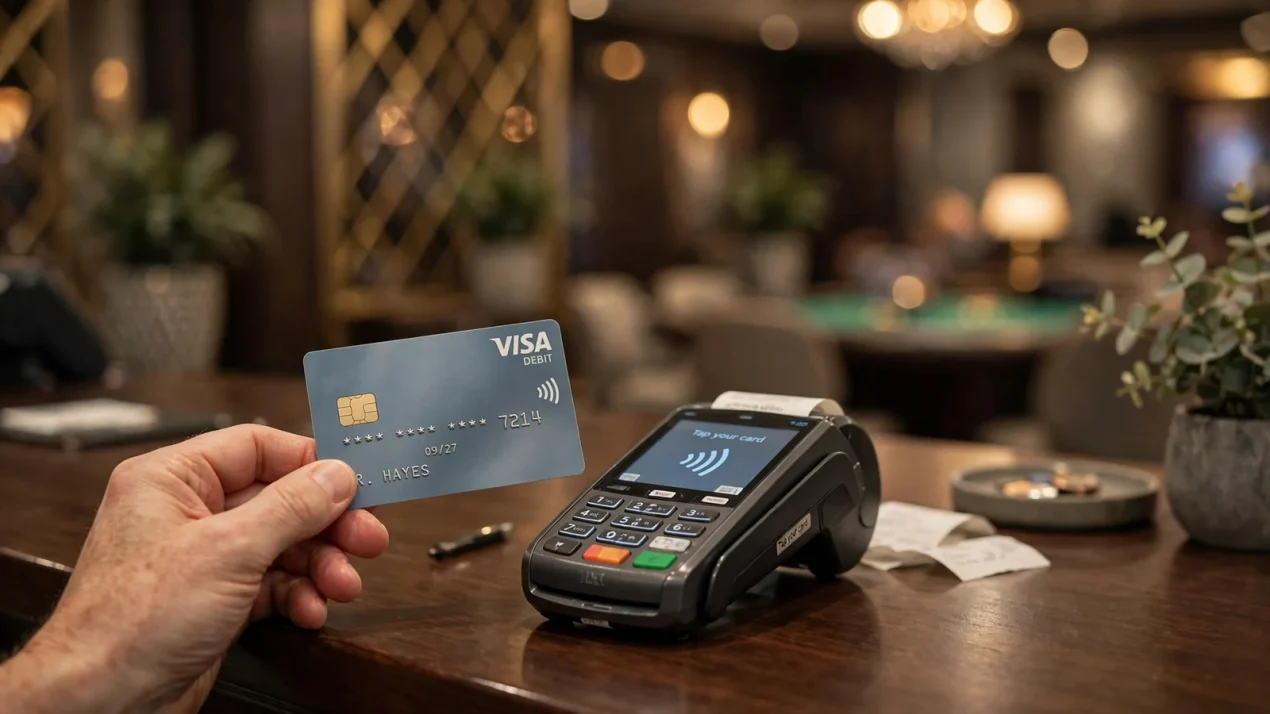
Debit cards occupy a familiar place in the UK casino cashier. Visa and Mastercard are commonly accepted, so a cardholder may see either network listed among the available payment methods. That broad picture is useful, but it is not a promise that every card carrying one of those names will work at every casino. Acceptance is a feature of the particular cashier and the card product presented to it.
The distinction matters because a network logo says which payment system a card belongs to; it does not, by itself, describe every feature of the card. A Visa debit card and a Mastercard debit card are not interchangeable in every cashier simply because both are debit cards. The payment options visible to an account can vary, and the card product may affect whether a listed method is available.
Payment-method pages and specialist casino reviews may list Visa and Mastercard for a casino, but those descriptions are only a starting point. Availability can change, and a general list cannot establish that a particular card is eligible at the time of a transaction. The cashier is the practical reference: it shows which methods the casino currently presents, while the card issuer identifies the product held by the customer. Both parts of that picture matter.
This makes the phrase “casino accepts debit cards” slightly broader than it sounds. It describes a payment category, not a universal approval for every card, account or situation. A casino may support Visa debit without supporting every product issued under the Visa name; the same qualification applies to Mastercard. The cashier may show a network, while the individual card still falls outside the products that can be used there.
That gap between a category and a specific card is not peculiar to gambling. Payment networks are shared infrastructure, and their logos are designed to be instantly recognisable. The casino’s cashier, however, has to translate that infrastructure into options it can actually process. The result is less tidy than the symbols on a card: a familiar logo can indicate a route worth checking, not an unconditional yes.
Casinos That Accept Diners Club in the UK
For the same reason, a list of debit card casinos should not be read as a ranking of cards or as evidence that every listed casino accepts every debit product. “Accepts Visa” and “accepts Mastercard” are useful descriptions, but they leave room for differences in current availability and card eligibility. A careful account of payment options treats the brand name as the beginning of the check, rather than its conclusion.
There is also a basic distinction between a debit card and the broader world of card payments. The subject here is a debit product linked to an account, not a card merely because it carries a familiar network mark. Names such as Visa and Mastercard identify networks used across different kinds of cards; the word “debit” remains important. A cashier listing a network does not make every card under that network suitable for the same transaction.
This is why online casinos that accept debit card deposits are best understood as casinos whose cashiers offer a debit-card route, subject to the cashier’s current options and the card product’s eligibility. The wording can sound definitive, particularly in a short payment-method label. In practice, it is a compact description of a system with more than one moving part.
The useful first distinction, then, is not between a supposedly superior network and an inferior one. It is between general acceptance and specific compatibility. UK casinos commonly support Visa and Mastercard debit cards; the precise option available still has to be checked where the payment methods are displayed. A broad market habit is not an individual guarantee. Familiar, not automatic.
This is the modest but important meaning of debit card acceptance in a casino cashier. It indicates that debit cards are a standard payment category in the UK market, with Visa and Mastercard among the commonly accepted networks. It does not settle whether a particular card product is currently supported. The cashier supplies the current list; the card’s own type supplies the other half of the answer.
Recommended online casinos
- JetsetspinsBonus: 200% Bonus + 100 Free Spins + Free Royal Wheel · Payout speed: 1-3 business days
- ChanzeBonus: Slots Welcome Bonus #1 200% up to €500 · Payout speed: 1-3 business days
- SlotoSportBonus: 500% up to £ 10 200+ 777 FS · Payout speed: 1-3 business days
- SpinFormulaBonus: 550% Up To £15,000 + 550 FS · Payout speed: 1-3 business days
- EvoSpinBonus: 125% up to €2500 + 125 Free Spins · Payout speed: 1-3 business days
- ZombillionBonus: Welcome Pack 250% up to £4000 + 200 FS · Payout speed: 1-3 business days
Online Deposits, Limits and Account Currency
A debit-card deposit has more than one boundary. The amount entered at the cashier must fit the casino’s minimum and maximum, the card method’s own rules and any limits attached to the account. These figures are not universal: they can change with the payment method and account status. A number shown beside one cashier option should not be treated as a general rule for every card or every customer.
A specialist review of casino payment terms reports minimum deposits typically in the £10–£20 range, though the exact threshold depends on the selected method.
A specialist review of casino payment terms reports minimum deposits in the £10–£20 range, with the threshold depending on the selected method. That is a guide to what may appear on an individual site, not a fixed UK-wide tariff. The amount shown at the cashier is the operative one. If the minimum is higher than the intended deposit, the transaction cannot simply be entered below it; if it is lower, that does not make a larger deposit appropriate.
Maximums are less tidy. A casino may set a cap for one transaction and separate limits for a day or a month, while the payment method and account status can affect what is available. The amount accepted at one point may therefore differ from the amount permitted later or through another cashier option. These are transaction parameters, not promises about what a card issuer will approve. An entered amount can meet the casino’s stated ceiling and still be declined elsewhere in the payment chain.
The cashier is where those parameters become concrete. Its displayed minimum and maximum should be read together, rather than treating a general payment page as a complete statement of what a particular account can do. Where the cashier shows an account-specific limit, that is more relevant than a broad figure described elsewhere. Small print matters here, though it rarely tries to look important.
Account currency is another parameter worth settling before the first transaction. A specialist review reports that GBP is supported on the pages it assessed, but this should not be taken as a guarantee for every account or current cashier. The account’s currency should be confirmed before depositing. If the account is set to a different currency, a card payment entered in pounds may be converted, and the resulting balance may not match the amount expected. Currency is not a decorative setting; it changes how the transaction is recorded.
Casinos That Accept Wirecard in the UK
A clear display of the deposit amount and account currency helps make the transaction intelligible before it is authorised. If the cashier presents figures in a currency other than GBP, the displayed amount should be understood before proceeding. The same applies where an account’s currency is selected during registration or later through account settings: a default should not be mistaken for a deliberate choice. These checks are about knowing the value being entered, not about comparing payment routes or their charges.
There is also a limit that is not simply a cashier ceiling. UK Gambling Commission rules require remote gambling operators to prompt new customers to set a financial limit before making a first deposit. They must also make account-level limit controls accessible. The prompt places a decision about spending alongside the opening of the account, rather than leaving all control to a later moment. The exact controls and their presentation can differ, but they belong to the account, not just to a single card transaction.
That distinction matters. A cashier maximum sets what can be deposited under particular conditions; a financial limit is a personal control over gambling spend. One does not replace the other. A deposit can be below the method’s maximum while still exceeding the amount chosen as a sensible account limit. Equally, an account-level setting does not alter the minimum required by a payment method. They answer different questions.
A deposit can be below the payment method’s maximum while still exceeding a personal account-level financial limit.
The account controls should remain easy to find after the first deposit, since a limit chosen at registration is not merely a box to clear before reaching the games. It is part of the framework remote operators are required to provide. A pause to establish a financial boundary belongs before money enters the account, not after a pattern of spending has already formed.
In practical terms, the amount, currency and applicable limits should agree before a debit-card transaction is submitted: the intended sum must fall within the cashier’s current parameters, the account should be denominated as expected, and the financial limit should reflect a considered boundary. A casino cashier can define what it will accept. It cannot decide what a person can afford.
Choosing a Debit Card Casino Without a Name-Check
A useful comparison of UK debit card casinos begins with the cashier, not a league table. A site may describe card payments on a general information page, but the options shown for a particular account are the practical test. Availability can change, and a payment logo is not a promise that every card product will work.
The same caution applies to lists of “best” casinos. Without current, comparable information about the cashier and its terms, a ranking gives a confident shape to a variable situation. A better assessment asks whether the payment rules fit the account that will actually be used.
Casinos That Accept Bitcoin in the UK: Evidence
Start with the casino’s UK status. Remote gambling licensees serving Great Britain must hold the relevant UK Gambling Commission licence. The public register provides a way to check that status before depositing; a familiar brand name or polished payment page is not a substitute. This is a basic distinction in a market where legal access depends on the operator’s licence, not merely on where its website is based.
Then compare the account details the casino requires with the details attached to the payment route. When both belong to the same customer, routine ownership checks are less likely to interrupt a transaction. A mismatch in names or account information can create avoidable friction, even when the card itself is accepted. The point is not that matching details guarantee approval; they simply leave fewer elementary inconsistencies to resolve.
This is also where household arrangements deserve care. A card belonging to a partner or relative is not interchangeable with one held by the casino account holder. The cashier may accept a card brand while the operator’s terms still require the payment account to match the customer. Compatibility means more than a familiar logo.
Read the payment terms alongside the cashier. Look for which card options are currently offered, whether the casino places conditions on eligible cards, and whether the stated payment route is available for both deposits and withdrawals. A payment method described only in an old review may no longer appear in the account. The cashier is the live noticeboard; archived claims are less useful.
Do
- Confirm the operator’s current UK Gambling Commission status
- Check for debit card options in the live cashier
- Verify that the same route supports both deposits and withdrawals
Don’t
- Rely on league tables or “best” casino rankings
- Use a card belonging to a partner or relative
- Trust outdated third-party payment lists
Limits are another point of comparison, though not a reason to assume that every player sees the same figures. A specialist review of casino payment terms notes that maximum deposits can differ by transaction, day or month, and may also depend on account status. The relevant terms should therefore be checked against the actual cashier rather than treated as a fixed property of the casino. A limit that is suitable for one account may not apply to another.
Account status can also affect what is available. A newly created account and an established one may not present identical payment conditions. This makes a dated third-party list a poor basis for a firm decision: it can describe a former cashier, an earlier set of terms or a different account context. A current operator page is more informative, but the account itself remains the final check.
A sensible comparison can be kept short:
- Confirm the operator’s current UK Gambling Commission status.
- Check that debit card payment appears in the account cashier.
- Read the terms for card eligibility and account-name requirements.
- Compare the stated limits with those displayed for the account.
- Confirm that the same route is supported for deposits and withdrawals.
This approach does not produce a universal winner. It produces a more useful answer: whether a particular UK debit card casino fits the payment account, the account holder and the operator’s current conditions. The small print does the sorting.
Making a Casino Deposit by Debit Card
A debit card deposit is a direct way to move money from a bank account into a casino balance. The usual sequence is simple: open the cashier, choose the card option shown there, enter the deposit amount and the requested card details, then confirm the transaction through the casino’s payment flow. If the payment is approved, the balance can be available straight away.
A specialist review describes card deposits as capable of being instant. That is useful for understanding the deposit side, but it is not a promise that every transaction will clear immediately. The card issuer may decline a payment, the casino’s system may need to process it, or the cashier may not offer that card for the account in question. “Instant” describes a possible result, not a law of nature.
Casinos That Accept iDEAL in the UK: What to Check
The cashier is the practical test. A casino’s general payments page or an older description may list Visa and Mastercard, but a specialist review notes that current UK availability and eligible card products need to be checked in the cashier itself. The options displayed when logged in are more relevant than a broad claim on a landing page. Card acceptance can depend on the product, so a Visa debit card being familiar does not by itself settle whether that particular card will work.
Once the card option is selected, the amount is entered in the deposit form. The page should show the transaction details before confirmation; after approval, the casino balance should reflect the funds. If the payment does not complete, repeating it immediately can create uncertainty about whether the first attempt is still pending. The sensible first step is to check the cashier and any transaction status, rather than assume that a missing balance means the money has disappeared.
A debit card casino deposit is therefore less mysterious than the surrounding language of payment pages can make it sound. The card provides the funding route; the cashier determines whether that route is currently available and what information is needed. There is no need to treat the payment method named on a general site page as a guarantee for every card in a wallet.
Making a Deposit
Open the Cashier
Access the casino cashier and select the available debit card option.
Enter Details
Input the desired deposit amount and the required card information.
Confirm Transaction
Review the transaction details on the payment flow screen and authorize the payment.
The distinction between an available card option and a successful payment matters. A cashier may display a method, yet the issuer can still reject a particular transaction. Conversely, a casino may accept debit cards in general while showing only the options it supports for that account. The deposit flow, rather than the logo alone, reveals the usable route.
For a player using debit card slots in the UK, the payment step remains separate from the game itself: funds first need to appear in the casino balance before they can be used. A card deposit may do that quickly, but the payment screen is where the current choice is confirmed. Small interface, decisive answer.
Why a Card Deposit Does Not Mean a Card-Speed Withdrawal
A debit card can move money into a casino account almost at once, yet a casino withdrawal to a debit card follows a different chain. The deposit is a request to add funds; a payout is money leaving the operator, and it may need approval before the payment provider can send it on. The same card name on both sides does not make the journeys mirror images.
A specialist casino review describes card deposits as potentially instant, while a payout can take several business days. That is a reported experience, not a timetable that applies to every casino or card. The important distinction is between the casino’s processing and the later delivery of funds. A withdrawal can be waiting for approval before it has even entered the card-payment stage.
Casinos That Accept Instadebit in the UK: How to Check
The casino’s internal review is one part of the clock. A request may need to be checked and authorised; only after that can the payment be passed onward. A specialist review notes that this approval stage can extend the wait, particularly on a first withdrawal when account verification is still being completed. The processing time shown by a casino may therefore describe its own handling, rather than the full period until the funds appear in a bank account.
Verification matters because a payout is not simply a reversed deposit. The casino may need to establish that account details and identity checks are in order before releasing money. If information is outstanding, the request can remain pending while the review takes place. A fully verified account and an uncompleted check are not equivalent starting points, so reports of a fast withdrawal do not by themselves predict another customer’s experience.
There is also a reason payouts are commonly directed back to the original payment source. UK anti-money laundering rules generally require funds to return that way. In practice, this means a casino withdrawal to a debit card may be routed to the card used to fund the account, rather than sent wherever is most convenient at the moment of withdrawal. The rule serves a financial-control purpose, not a promise of faster delivery.
This can make the phrase “fast withdrawal” misleading when it is treated as a single speed. It may refer to the casino approving a request quickly, to the payment being sent promptly after approval, or to the time before the bank records it. Those are separate stages. A delay at one does not necessarily mean the others are slow, but the player sees only the final arrival unless the casino provides a clear status.
UK anti-money laundering rules generally require that casino withdrawals be routed back to the original payment source used for funding.
For a debit card casino withdrawal in the UK, the practical measure is therefore not the speed of the original deposit. It is how the casino handles approval, whether verification is complete, and what delivery period it states after releasing the payout. A card can be immediate on the way in and slower on the way out. Different jobs.
When Another Payment Route Fits Better
A debit card is familiar because it sits inside the ordinary banking system, but it is not the only way to move money into a casino account. The alternatives differ less in appearance than in what they are built to do: connect a bank account, pass through a wallet, or provide a deposit without a direct card transaction.
PayPal is a wallet option where the cashier supports it. A specialist review describes it as popular for speed and convenience, though that is a reported assessment rather than a promise that every casino will offer it or handle it in the same way. Its presence can make a card unnecessary for a deposit, but the payment method shown at one site should not be assumed to appear at another.
Open banking services and bank transfers connect the casino payment to a bank account rather than a debit-card number. A specialist payment review reports that these routes can allow instant deposits and fast withdrawals at many sites. “Can” matters: the service has to be available in the cashier, and a transfer is not a single uniform process. Bank transfers also sit within the familiar banking framework, while open banking is presented as a direct account connection.
Prepaid vouchers take a different path. Paysafecard is a voucher that can be used for deposits, but it is deposit-only; it is not a route for receiving a casino payout. That makes it a one-way funding choice rather than a substitute for a debit card across the full payment cycle. A tidy distinction, if not a complete one.
Some casinos also list e-wallets such as Skrill or Neteller. Their availability is site-specific, so their names in a payment guide do not establish that either option will appear in every UK cashier. These wallets can suit someone who already uses that service, but they remain separate payment products rather than another form of debit card.
Casinos That Accept Upaycard in the UK
There is no single alternative that replaces a card in every circumstance. A wallet may offer a different deposit route; bank-linked services may support both incoming and outgoing transactions where the casino provides them; a prepaid voucher covers deposits only. The cashier is therefore more useful than a generic payment list: it shows which methods are actually enabled for the account, and whether the method is available for deposits, withdrawals or both.
For someone comparing a casino with debit card access against other payment routes, the practical distinction is functional. Cards link the transaction to a bank card; wallets and open banking introduce another service; a voucher funds the account without serving as a withdrawal channel. Different plumbing.
Payment Ownership, Fraud Checks and Card Rules
A casino that accepts debit card payments still has to establish whose money is moving. When the name and account details on a casino profile match those attached to the payment route, basic ownership checks are less likely to interrupt a transaction. The point is not ceremonial neatness: remote gambling licensees have to account for the movement of funds, and a mismatch can leave a payment needing clarification.
That is one reason closed-loop rules matter. Under anti-fraud and anti-money-laundering controls, a casino may return funds to the source from which they came rather than send them through an unrelated route. A familiar payment method does not override that process. Nor does a different route necessarily fail; it may simply call for further checks before the transaction can be completed.
Alternatives can make the trail less direct. A payment service, wallet or bank route may involve account details that need to be linked back to the casino customer. Where that link is not immediately clear, the operator may ask for more information or verification. The consistent use of one customer’s own account and payment route can therefore reduce avoidable friction, though it cannot remove the operator’s checks.
There is a firmer boundary for credit cards. The UK regulator prohibited credit-card payments for gambling on 14 April 2020, and the prohibition remains in force. A debit card is not a credit card merely because both may carry a familiar card-network name; the underlying product matters. A casino that accepts debit card deposits UK-wide cannot treat credit funding as an acceptable substitute.
Casinos That Accept Tether in the UK: Payment Checks
The restriction also follows the funds beyond the plastic card. Credit-card money routed through a money service business is still prohibited for gambling, as is a wallet payment where the wallet permits credit-card funds to be used for gambling. Changing the route does not change the character of the money.
These rules sit alongside ordinary ownership checks rather than replacing them. A payment may be permitted in principle yet still need review if account details do not line up or the source of funds is unclear. The distinction is plain, if administratively inconvenient: debit is allowed; credit is not.
Debit Card Bonuses and the Eligibility Catch
Paying by debit card does not, by itself, decide whether a casino promotion applies. A welcome offer may have separate rules about who can claim it, how to activate it and which payment methods qualify. The card can be accepted at the cashier while a particular offer remains unavailable to an account using another method. The distinction is easily missed when “debit card casino bonus” sounds like a single product rather than a set of terms attached to an offer.
Payment rules can be less intuitive for digital wallets. A specialist review reports that PayPal, despite its speed and convenience, may be excluded from bonus eligibility. A separate specialist review describes Skrill and Neteller as often excluded from promotions at sites where they are available. These are not universal rules: terms can differ between casinos and between offers at the same casino. The offer’s own conditions are the deciding text.
That matters when comparing a casino welcome bonus in the UK. A promotion should be checked for its payment-method exclusions before a deposit is made, rather than inferred from the cashier’s list of accepted options. The two lists answer different questions: one concerns whether a transaction can be made; the other, whether that transaction qualifies for a promotion. A familiar card brand is no substitute for reading the offer.
The same distinction applies to searches for a debit-card casino or a debit-card slot in the UK. The payment method does not identify a special class of games, nor does it establish that every promotion is available to every customer. A casino may accept debit cards and still set conditions that narrow bonus eligibility. The label is not the rule.
Payment methods like PayPal, Skrill, and Neteller may be excluded from bonus eligibility depending on the casino’s specific terms.
Promotional terms are less glamorous than the headline offer, but they carry the practical detail: qualifying methods, exclusions and any steps required to claim. A bonus advertised beside card payments should not be treated as confirmation that every route into the account qualifies. For a cautious comparison, the relevant question is not simply whether the casino accepts a debit card, but whether the specific offer permits the intended payment route. No universal shortcut.
Deposit Fees, Exchange Rates and the Real Cost
The amount entered for a casino deposit by debit card is not always the amount that ultimately leaves a bank account. A specialist payment review identifies several possible layers of cost: a charge from the casino, a fee from the payment provider, a charge imposed by the card issuer or bank, currency conversion, and network costs. Any one of them may be absent; the point is that the cashier’s figure is not necessarily the whole bill.
Currency is an especially quiet expense. If a transaction is converted between currencies, the exchange rate may include a spread: the rate applied to the payment can be less favourable than the rate used as a reference. That difference may matter more than a visible flat fee. A transaction can therefore look free at the casino end while costing more through conversion.
Card schemes and banks do not make those costs identical. A debit card casino deposit may be treated differently by the casino, provider or issuer, and fees can depend on the particular transaction. The same payment route is not a promise of the same final cost each time.
The useful comparison is not a slogan such as “fee-free” but the total cost of the actual amount being deposited. Casino charges, provider fees, bank or issuer fees, currency spread and network costs all belong in that calculation. If the amount is converted, the rate itself deserves attention alongside any separately displayed charge.
Casinos That Accept USDC in the UK: What to Check
This also explains why there is no universally cheapest way to fund a casino account. A route with no visible fee may carry a conversion cost; another may show a charge but avoid that spread. The answer depends on the transaction, not on the payment method’s reputation. Payment pricing is less theatrical than a bonus banner, and often more consequential.
Visa Debit Acceptance Is Not the Same as a Guarantee
Visa debit is commonly listed among payment methods at UK casinos, but a logo on a general payments page is not a promise that every card will work. A specialist review may report Visa and Mastercard as accepted options; current UK availability and eligibility still depend on the casino’s cashier and the particular card product.
That distinction matters because “Visa debit” describes a network and card type, not a universal route through every bank, issuer and casino. A card may be debit rather than credit and still not appear as an available option, or a transaction may not be supported by the cashier. The payment screen is the practical test, not an old list copied across the internet.
For a safe debit card casino choice, the useful standard is therefore modest: the operator should be properly authorised for the UK market, and its live cashier should show the relevant debit option. The UK Gambling Commission requires remote gambling operators serving Great Britain to hold the appropriate licence. That says something about oversight; it does not guarantee that a particular card product will be accepted.
The boundary with credit cards is firmer. On 14 April 2020, the regulator prohibited credit-card payments for gambling, and the rule remains in force. A casino’s acceptance of Visa debit does not extend to Visa credit. The distinction is not a technical footnote but part of the UK’s attempt to prevent gambling from being funded through borrowed card credit.
So the phrase “Visa accepted” needs a final qualification: accepted where, now, and on which product? The cashier supplies the answer. Logos are less decisive.
Are Visa and Mastercard deposits definitely debit cards?
No. Visa and Mastercard are payment networks used by different card types, so check that your card is a debit card and that the casino cashier currently accepts that specific card product.
Can I use a credit card at 333 Casino in Great Britain?
No. Credit card gambling has been banned by the UK regulator since 14 April 2020.
Can I deposit in GBP?
Yes, GBP is supported. Confirm your account currency before depositing to avoid conversion.
What is the current minimum deposit?
Minimum deposits usually start at £10–£20, depending on the payment method. Check the amount displayed in the casino cashier.
Which method has the lowest fees?
There is no universally lowest-fee method. Compare the casino’s charges, provider and bank fees, currency-conversion spread, and any network costs for your transaction.
Related posts

Terms of Use

Responsible Gambling
