
Online Casino Game Shows in the UK: What to Know
 Available in GB
Contents
These formats combine chance-based gambling with television-style hosting, performance and shared anticipation.
The Appeal of Live Casino Game Shows
A casino game show borrows its public face from television. It belongs to the same family of entertainment that turns uncertainty into a shared spectacle: a host addresses an audience, a result is awaited, and the interval before that result becomes part of the event. The casino setting changes the stakes, but the presentational inheritance is familiar. It is not simply a game dressed up for the camera. It is a meeting of two old forms: gambling, with its private calculation of chance, and entertainment, with its public choreography of anticipation.
That combination helps explain why live casino game shows occupy a different corner of online play from conventional casino games. A slot or a table game can be understood primarily through its rules and outcomes. A game-show format asks for attention to the performance around them as well. The appeal is not only what happens, but how the event is framed: the pauses, the announcement, the sensation that a result is arriving in the present rather than being summoned by a button and absorbed in silence.
This is a difference of emphasis, not a clean division. Casino games have always borrowed from theatre. A roulette wheel has its own small ceremony; cards are turned with a flourish; even a simple win can acquire the character of a reveal. The game show makes that theatrical element more explicit. It gives suspense a visible stage and makes the sequence of play feel like a programme rather than a bare transaction. The result remains uncertain. The packaging gives the uncertainty a voice.
The word “live” contributes to this impression. It suggests an event unfolding now, with a human presence and a shared clock, rather than an isolated encounter with an automated game. That sense of immediacy can make a session feel less like operating a piece of software and more like joining a broadcast. But the feeling of presence should not be confused with personal participation in the ordinary social sense. Watching a host perform does not make the audience a roomful of companions, and a live presentation does not turn chance into a conversation. The screen remains a screen.
Online Casinos With No Limits: UK Rules Explained
Still, screens have changed what audiences expect from entertainment. Television once placed the studio on one side of the living room and the viewer on the other. Online formats can make that boundary feel less settled: the viewer is no longer merely receiving a programme but encountering it within an environment designed around play. The old distinction between watching and doing grows hazy. A person may follow the event as entertainment, approach it as a game, or move between those modes without much ceremony. That ambiguity is part of the format’s pull—and part of the reason its appeal cannot be reduced to rules.
Conventional casino play, by contrast, often puts the mechanics in the foreground. The player’s attention is directed towards decisions, symbols, cards, or a repeated cycle of action and result. Its pleasures can be solitary and concentrated: a private rhythm, a self-contained contest with probability, a willingness to repeat a familiar action. None of that is inherently less entertaining. It is simply a different arrangement of attention. A game show makes more room for presentation; a traditional game may leave more room for the player’s own pace and interpretation.
Barcrest Online Casinos UK: What the Listings Prove
There is a social history in that distinction. The casino has long been imagined both as a place of individual calculation and as a public spectacle. Its mythology depends on both: the lone person studying a table and the crowd gathered around a dramatic outcome. Television game shows inherited the crowd’s role while bringing gambling’s uncertainty into a domestic setting. Online casino entertainment now places these traditions beside one another, where a viewer can encounter the language of a studio show inside a gambling product. The format is modern in its delivery, but its ingredients are not new.
The host is important to the idea, even when the attraction is not any particular personality. A human presenter offers a point of focus and a recognisable rhythm. Someone speaks while the result is pending; someone gives shape to a sequence that might otherwise be only a series of outcomes. This is a simple but consequential change. In a conventional game, silence can be functional: attention stays with the board, the cards, or the next move. In a show-like setting, silence itself can feel staged. The pause becomes part of the entertainment rather than an empty space between actions.
Amatic Games at UK Online Casinos: What to Know
That does not mean every viewer wants more performance. Some people prefer games that get directly to the point, and some find a host’s presence distracting. The same feature that gives a format its character can make it less suitable for a particular mood. The best live casino game shows, in the broad sense of what people seek from the category, are not necessarily the most elaborate or the most energetic. The central question is whether the presentation adds something that the player values, or merely places decoration around a familiar act of chance.
The word “show” also carries expectations that casino language alone does not. It suggests a sequence with a beginning, a middle, and a reveal; a moment of suspense that is meant to be noticed. A conventional game may have dramatic turns, but it does not have to present them as a programme. In a game-show setting, the act of waiting is treated as material. The design invites attention to the interval, not only to the outcome. That can make chance feel more legible, even when it does not make it more predictable.
This distinction matters because spectacle has a persuasive force of its own. A polished presentation can make an experience seem more substantial, more sociable, or more consequential than its underlying structure. Yet atmosphere is not evidence of control. A presenter can heighten anticipation but cannot make an uncertain result safer or more favourable. The show can give chance a face. It cannot give chance a conscience.
For some, the attraction lies in this mixture of familiar television cues and casino risk. A game show is usually associated with leisure, performance, and the anticipation of a reveal; a casino is associated with wagering and outcomes that matter to the person playing. Put together, they create an unusual tone. The event can feel light in its presentation while remaining serious in its financial dimension. The contrast is not necessarily a flaw, but it deserves to be seen clearly. Entertainment language can soften the edges of an activity without changing what the activity is.
IGT Online Casinos in the UK: Licensing and Games
The online setting sharpens that contrast. A physical casino places gambling within a location, with its own architecture, rituals, and social conventions. A digital casino strips away much of that surrounding world and replaces it with an interface. A live game show can restore some sense of occasion, not by recreating a casino floor, but by borrowing the grammar of broadcast entertainment. The result is neither simply television nor simply a traditional casino game. It is a hybrid, and hybrids often appeal because they let people recognise more than one kind of pleasure at once.
There is a question of pace, too. A conventional game can feel self-directed: attention gathers around the player’s actions and the game’s response. A show-like format places more emphasis on a presented sequence. That difference may suit people who want an event to follow, rather than a game to operate in isolation. It may also feel less immediate to those who value control over tempo. Neither preference is especially revealing about a person’s character. Entertainment often depends on the smallest practical distinction: whether the mind wants to act, observe, or alternate between the two.
The category’s language can obscure those distinctions. “Casino game show” sounds like a single, settled genre, but the phrase also gathers together several expectations: the presence of a host, the atmosphere of a broadcast, the uncertainty of a casino game, and the possibility of participation. Not every product that borrows the vocabulary of television will offer the same balance. A name or a glossy presentation cannot establish what the experience is like. The relevant question is what actually occupies the screen and how the game asks for attention.
This is why broad rankings are less useful than they appear. “Best” depends on what the player values: more spectacle, less interruption, a strong sense of occasion, or a straightforward game with little performance around it. Those preferences cannot be collapsed into a universal order. A show that feels engaging to one person may feel overproduced to another; a spare format may seem refreshingly direct or simply flat. The category offers a mode of presentation, not a guarantee of enjoyment.
Amatic Online Casinos in the UK: How They Work
The attraction, then, is not mysterious. A live casino game show turns the interval before an uncertain result into a performance, and performance gives that interval shape. It borrows the shared attention of television and places it beside the individual stakes of casino play. For some, that makes the experience more vivid than conventional games; for others, the extra theatre is beside the point. Both reactions make sense. The format’s defining quality is not that it replaces the casino game, but that it asks the game to appear before an audience.
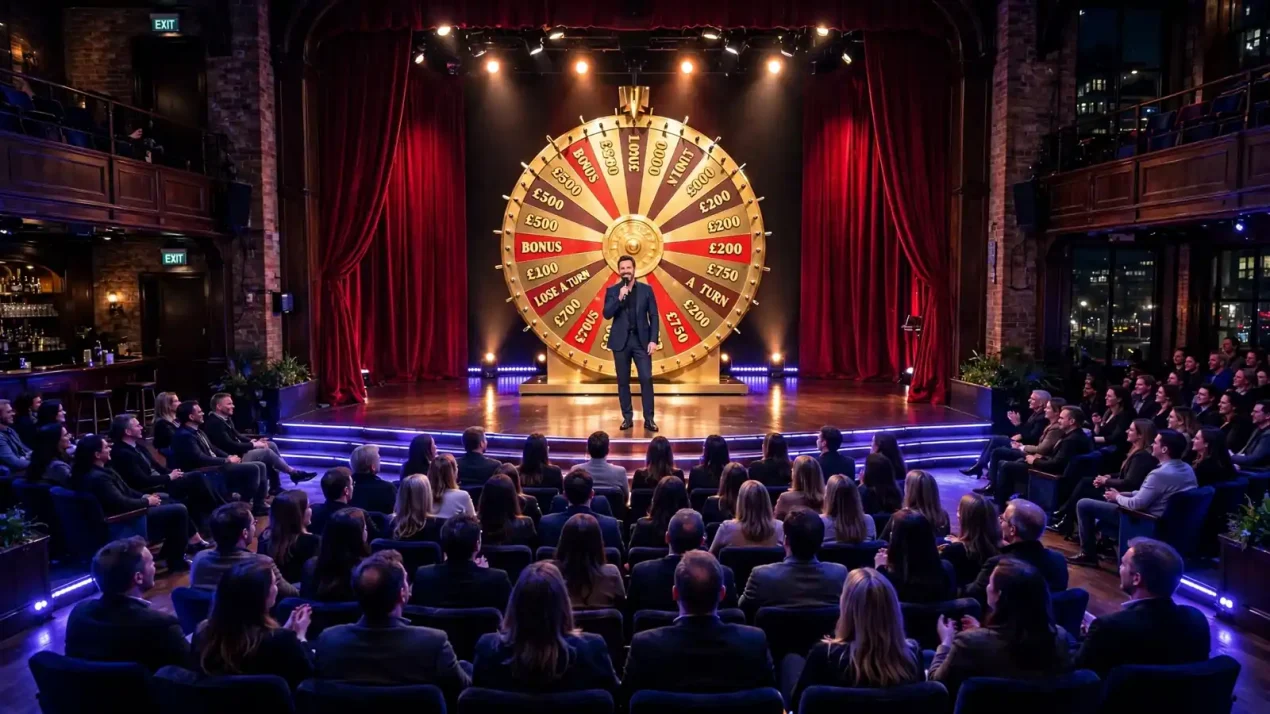
A stage, in miniature.
Recommended online casinos
- JetsetspinsBonus: 200% Bonus + 100 Free Spins + Free Royal Wheel · Payout speed: 1-3 business days
- ChanzeBonus: Slots Welcome Bonus #1 200% up to €500 · Payout speed: 1-3 business days
- SlotoSportBonus: 500% up to £ 10 200+ 777 FS · Payout speed: 1-3 business days
- SpinFormulaBonus: 550% Up To £15,000 + 550 FS · Payout speed: 1-3 business days
- EvoSpinBonus: 125% up to €2500 + 125 Free Spins · Payout speed: 1-3 business days
- ZombillionBonus: Welcome Pack 250% up to £4000 + 200 FS · Payout speed: 1-3 business days
Casino Access and the Rules Behind It
A live show can arrive on a screen from a studio far from the person watching it. In legal terms, that distance does not move a casino beyond British oversight. The central question is not where the cameras, servers or other key equipment happen to sit, but whether remote gambling is being offered to consumers in Great Britain. The UK Gambling Commission regulates that activity regardless of the equipment’s location.
That principle gives online casino access a distinctly territorial character. A business may be based elsewhere and still need the relevant UKGC licence to serve the British market. The regulator’s reach follows the commercial activity across the network; it does not stop at a data centre’s front door. For an online casino carrying live game shows, the setting may look international, but the operator’s obligations are local.
The Commission regulates gambling activity in the United Kingdom, including online casinos, and is the sole regulator for commercial gambling in Great Britain. The distinction matters: “United Kingdom” and “Great Britain” are not interchangeable legal labels. The Gambling Act 2005 governs gambling in England, Wales and Scotland, but not Northern Ireland. So a description of the framework for British online casinos should not quietly turn into a claim about every part of the UK under one identical law.
Regulatory Compliance
An offshore operator without a UKGC licence sits outside the British regulatory system and is not authorised to lawfully offer remote gambling to consumers in Great Britain.
The operator is the point of responsibility
A casino’s public face may be a polished lobby, a presenter’s studio or a collection of branded games. Behind that face sits a licensed business responsible for offering gambling to customers. In Great Britain, operators offering real-money gambling to customers in England, Scotland and Wales must hold a UKGC operating licence. A foreign address does not remove that requirement when the service is directed at the British market.
The Commission grants operating licences to businesses and personal licences to individuals working in relevant roles. Those are different permissions for different purposes: one authorises a business to conduct specified gambling activity; the other applies to people whose work falls within the licensing system. A licence is not a decorative badge that belongs to a website’s design. It identifies a regulated activity and the party responsible for carrying it on.
This distinction is useful when the machinery of a casino is divided among several firms. One business may supply software, another may operate the website, and other services may support the platform. The existence of a licensed supplier does not make that supplier the casino operator. For customers, the business accepting deposits, setting the terms of play and handling the account is the significant counterparty. The licence attached to the operator is therefore not interchangeable with a supplier’s permission to provide software.
Wazdan Casinos UK: Games, Operators and Bonus Rules
The same logic applies when live entertainment is part of the offer. The word “live” describes the presentation, not a separate legal status. A streamed show does not create an exemption from the rules governing remote gambling, nor does a studio’s location decide whether the British operator needs a licence. The regulatory question remains attached to the gambling service offered to consumers.
A licence is a framework, not a guarantee of taste
A UKGC licence places an operator within the British regulatory system. It does not mean every game or promotion will suit every customer, nor does it turn a commercial website into a public service. Regulation establishes responsibilities; it does not abolish the commercial nature of gambling. The distinction is worth keeping. A regulated casino remains a business selling gambling, only one required to operate under the rules applicable to the British market.
That framework affects the ordinary shape of an account as well as the legal status of the company behind it. UKGC-licensed operators must ask customers to set a financial limit before the first deposit, and a request to lower that limit must be applied immediately. GamStop has been mandatory for all online operators licensed in Great Britain since 31 March 2020. These are not features invented by a particular casino’s marketing team. They are part of the conditions surrounding access to licensed remote gambling.
Slot Stake Limits
For online slots, the stake limit per game cycle is £5 for players aged 25 and over, and £2 for those aged 18 to 24.
There are also rules that apply specifically to online slots. Autoplay is prohibited, and a minimum interval of 2.5 seconds must separate spins. The stake limit per game cycle is £5 for players aged 25 and over and £2 for those aged 18 to 24. The lower limit for younger adults came into effect on 21 May 2025; the £5 limit for older adults took effect on 9 April 2025. Those limits concern online slots, not every form of casino activity. Treating them as a universal stake rule would confuse one product category with another.
The distinction can matter in a casino that places slots alongside live entertainment. A single account may contain different forms of gambling, but rules do not become identical simply because the games share a lobby. The operator must apply the relevant requirements to the activity in question. A tidy website can make unlike products appear to belong to one seamless experience. The law is less impressed by interior design.
Bonus terms sit within the same regulatory landscape. The Gambling Commission’s cap on wagering requirements for bonus funds became effective on 19 December 2025 and sets a ceiling of 10 times the bonus amount. That limit governs how much playthrough can be required; it does not mean all bonuses are equal, or that a promotional offer has no other terms. A bonus remains a contract-like set of conditions presented by the operator, and those conditions should be read as part of the offer rather than as a footnote to the headline.
What “licensed” does and does not tell anyone
A licence answers an important question: whether the operator is authorised to offer the relevant remote gambling in Great Britain. It does not, by itself, establish that a particular live show is currently available, that a promotion is active, or that a customer will find a particular format appealing. Those are separate matters, and they can change independently of the operator’s regulatory status.
Betsoft Casinos in the UK: Games and Operator Checks
Nor should the presence of a familiar name in a casino lobby be treated as the same thing as proof of the operator’s licence. A game listing is a catalogue entry. Licensing concerns the business and the gambling activity it is authorised to conduct. The difference is basic, but websites often arrange everything on one screen: games, payment information, promotions and corporate details. Visual proximity is not legal equivalence.
The Commission’s role is also not to make every online casino identical. Licensed operators may present their services differently, and the entertainment on offer may vary. What unites them is not a shared style of show but their position within the regulatory structure. The licence is the threshold for lawful remote gambling in Great Britain; it does not prescribe a single aesthetic for the casino.
This helps explain why “best” is a slippery word in this context. One person may care about the range of live entertainment, another about account controls, and another about whether the terms are clear. Regulation provides a common floor for licensed businesses, not a ranking of their attractions. A legal status can be checked; a preference cannot be legislated into agreement.
There is a wider social idea inside that arrangement. Gambling is permitted as a commercial activity, but the permission is conditional. The state does not treat a remote casino as an ordinary online shop merely because both have a checkout and a customer account. It places gambling within a licensing system, with one regulator responsible for commercial gambling in Great Britain and distinct permissions for businesses and certain individuals. That is a deliberate boundary around a business whose product is risk.
Regulatory Summary
- UKGC licenses are mandatory for operators offering real-money gambling to customers in Great Britain.
- Licensing identifies the responsible party and is distinct from software supplier permissions.
- Regulation establishes a common safety floor but does not guarantee a specific aesthetic or preference.
- Access to a webpage or a professional-looking studio is not evidence of regulatory permission.
The border drawn by the licence
For a casino serving British customers, the location of its headquarters or technical equipment does not displace the licensing requirement. This matters particularly in remote gambling, where the service can be presented as placeless: a site opens on a phone, a stream comes from a studio, and the business may be registered in another country. The screen conceals geography. The regulatory test restores it.
An offshore operator without a UKGC licence sits outside the British regulatory system. It should not be described as though it were simply another licensed casino with a different address. The difference is not cosmetic. The British licence is the basis on which an operator may lawfully offer remote gambling to consumers in Great Britain. Without it, the operator is not covered by the UKGC framework.
That is why descriptions such as “international casino” can blur an important distinction. International may describe a company’s reach, but it does not describe its authority to serve a particular market. For British consumers, the relevant issue is whether the operator holds the appropriate UKGC licence, not whether its website loads or whether its studio looks professional. Access to a web page is not evidence of regulatory permission.
The law’s territorial logic may seem less dramatic than the show itself. It is also more consequential. A presenter can give a game a theme and a rhythm; only a licensed operator can lawfully offer the remote gambling service to British customers. The camera makes distance feel irrelevant. The licence says otherwise.
BGaming Online Casinos in the UK: What to Check
Crazy Time and Funky Time in the Search
Crazy Time and Funky Time are names that draw attention away from the broad category of live casino entertainment and towards particular show titles. That distinction matters. Someone looking for either title is not necessarily asking what a live casino game show is; the interest may be in whether a named game is available, what kind of experience it offers, or whether the name refers to the same thing wherever it appears.
A title, however, is a small piece of evidence. It can identify a product in a casino lobby, but it does not by itself explain the game, establish who supplies it, or confirm that a particular operator currently offers it. Nor does a name settle what “live” means in a listing. The useful details are the ones attached to the product itself: its description, provider information, rules and availability. Without those, assumptions have a habit of dressing themselves up as knowledge.
That restraint is especially useful with names that sound self-explanatory. “Crazy Time” suggests a mood; “Funky Time” suggests another. Those impressions belong to the language of branding, not to a reliable account of how either title works. A name may be designed to signal energy or spectacle, but it cannot establish the pace, format, presenter, features or outcomes of a game. Such particulars need to come from the game’s own information, not from the associations its title happens to invite.
Crazy Time
A specific live casino game title with its own distinct rules, features, and presentation style.
Funky Time
A separate live casino game title that should be evaluated on its own terms rather than by its name.
The two names also should not be treated as interchangeable simply because they share the word “Time” and sit within the same area of casino entertainment. Similar naming is not proof of a shared format, supplier or set of rules. Conversely, different names alone do not prove that two products have entirely different mechanics. The modest conclusion is the sound one: each title needs to be checked on its own terms.
A casino listing is a useful starting point, but it is not a complete description. The entry may show whether the game is currently available, while its information panel or rules explain what the title actually offers. If those details are brief, the operator’s help material may add context. This is less theatrical than guessing from a name, but considerably more dependable.
There is another small distinction hidden in the phrase “live casino game show”. It can describe a category, while Crazy Time and Funky Time are individual names within the conversation around that category. A person drawn to one title may be seeking its specific presentation rather than a general account of live casino entertainment. Keeping those levels separate prevents a broad description from being mistaken for a review of either game.
Availability is also not an eternal property of a title. A game may appear in one operator’s catalogue and not another’s, and a listing can change. A casino’s current lobby is therefore more informative about present availability than an old mention elsewhere. The game’s rules remain the proper place for mechanics; the operator’s listing remains the practical place to establish whether it is offered there.
Amatic Slots in UK Online Casinos: Supplier and Lobby
The names can carry a further kind of appeal: they are easy to remember, and easy to repeat. That makes them powerful labels, but memorable branding can encourage a false confidence that the product is already understood. In gambling, familiarity with a name is not familiarity with its rules. The difference is plain. One is recognition; the other requires reading.
For anyone comparing the two, the sensible comparison is not built from the titles alone. It depends on the details shown for each game: how it is described, what its rules say, and whether it is available through the chosen casino. If those particulars are not displayed clearly, the name cannot fill the gap. A vivid label is still only a label.
This narrow focus on Crazy Time and Funky Time should not be confused with a verdict on either title. Without dependable product details, claims about which is more exciting, more generous or more suitable would be decoration rather than useful guidance. The names identify the subject. The rules explain the game.
What “Live Casino Game Show” Means
The phrase joins three ideas that are easy to blur. “Casino” places the entertainment in a gambling setting; “game show” describes a recognisable style of presentation; and “live” signals that the experience is associated with a real-time broadcast rather than simply a piece of recorded entertainment. Together, the words point to a kind of casino product presented in the language of television entertainment.
Live Casino Game Show
A casino product that combines the gambling setting of a casino with the presentation style of a television game show, delivered via a real-time broadcast.
That is a description of the label, not a complete account of how any particular game works. The wording alone does not reveal what participants do, what determines an outcome, whether a presenter appears, or how any feature is arranged. Those details belong to the individual product. A title and its promotional description would need to establish them; the broad category name cannot do the work by itself.
This distinction matters because “game show” is a familiar cultural form, not a precise set of rules. Television has made the form legible through staged presentation, suspense and visible outcomes. Casino entertainment can borrow that vocabulary without reproducing any one programme or making every title operate in the same way. The label may set an expectation of spectacle, but expectation is not a mechanics guide.
“Live” can be especially suggestive. In ordinary usage it evokes something happening as it is broadcast, with an event unfolding rather than being watched as a finished recording. In a casino setting, the word therefore helps distinguish the presentation from a conventional digital game that runs without a live broadcast. Yet it does not, on its own, settle what is streamed, how the game is controlled, or what role any presenter may have. Those are product-level questions, not meanings hidden inside a single adjective.
The category also sits between two kinds of language. “Casino game” sounds like a description of the activity; “game show” sounds like a description of the form in which that activity is presented. The combined phrase can therefore describe entertainment whose appearance draws on show-business conventions while its setting remains a casino. Neither half cancels the other. A polished studio style does not turn the product into ordinary television, and the casino context does not make the word “show” meaningless.
New online casino sites in the UK: providers and offers
That is why the phrase is better treated as a broad label than as a promise of a standard format. It can help sort a type of entertainment from slots or table games in a catalogue, but it cannot tell the whole story of a particular title. Even the word “live” is not a substitute for a description of the actual experience. A viewer may reasonably infer a connection to real-time presentation, but should not infer unmentioned features from the label alone.
There is a small social history folded into the wording. Casino entertainment has long borrowed the language of spectacle: the reveal, the host, the moment when an uncertain result becomes visible. Television game shows made suspense into a domestic ritual, shared from a sofa rather than across a gaming table. When casino products use similar framing, they draw on a form already associated with collective attention and public performance. The appeal of the name lies partly in that recognition.
But recognition can be misleading if it is mistaken for equivalence. A television show is made for an audience; a casino product is defined by its own terms of play. Their surfaces may overlap, while their purposes and structures remain different. The title “live casino game show” does not explain where that boundary falls in any given case. It simply places the product where the languages of gambling and entertainment meet.
For someone trying to understand a listing, the sensible reading is modest: this is casino entertainment presented with game-show associations and described as live. Anything more specific requires the product’s own explanation. The distinction is useful precisely because it keeps the category from being asked to prove too much. A label can orient; it cannot replace the details.
The phrase may sound like a settled genre, but its meaning is more like a signpost. It points towards a blend of casino context and show-style presentation, while leaving the particulars to each game. No standard cast, sequence, or set of rules follows automatically from the words. The category is clear enough to recognise, and broad enough to demand care.
A label, not a rulebook.
Are Amatic games licensed and legal to play in the UK?
Yes. Amatic holds a UK Gambling Commission remote gambling software licence, and its games are offered to UK players through licensed casino operators.
What is the RTP of Book of Aztec and other top Amatic slots?
Book of Aztec has RTP versions of 90.57% and 97.63%. The same game can have different RTP versions at different casinos.
Must a casino be Gambling Commission-licensed to offer Amatic slots to UK players?
Yes. A casino offering online gambling to consumers in Great Britain must be licensed by the UK Gambling Commission; Amatic’s software licence does not replace the operator’s licence.
Which licensed UK casinos carry Amatic slots?
Reported UK operators carrying Amatic games include Betfred, Jackpotjoy, William Hill, kwiff, PokerStars, Ladbrokes, Paddy Power, Unibet, Virgin Games, Casumo, Sky Vegas, 32Red, 888casino, Bet365, Betway, Betvictor and Betfair. Check the casino’s current game catalogue before depositing, as availability can vary.
Can I deposit with cryptocurrency at a site offering Amatic slots?
No UK Gambling Commission-licensed operator was confirmed as accepting cryptocurrency for Amatic play. Offshore sites that offer Amatic games operate outside the UK regulatory framework.
What are the wagering requirements at Amatic casino bonuses in the UK?
For bonus funds at UK Gambling Commission-licensed operators, wagering requirements are capped at 10× the bonus amount.
Related posts

Terms of Use
Responsible Gambling